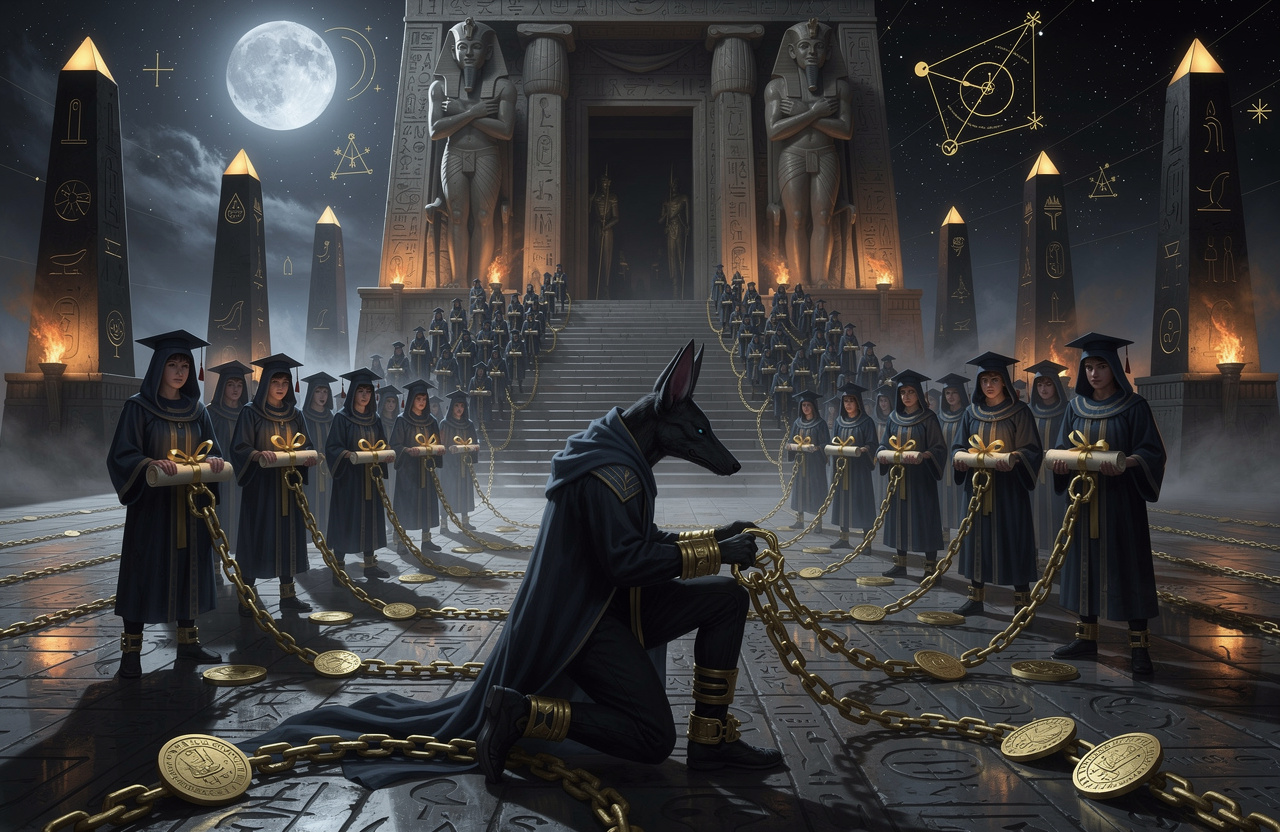
If you want to enslave a person for life, there's no point catching them as an adult — an adult already has experience, caution, the habit of counting. Far smarter to catch them at eighteen. At an age full of hope, knowing nothing about finance, sincerely believing that "education is an investment in the future." Slip them a contract for tens of thousands of dollars wrapped in beautiful words — and you get a person who starts adult life not from zero but from a minus. And they'll pay that minus down for decades. This isn't theory. It's how the American student-loan system is built, and it's spreading across the world.
Numbers that are hard to grasp
Student debt in the US is around two trillion dollars. Forty million Americans carry it. And — the key detail — a significant share of them will never fully repay it. The debt will hang on, accrue interest, get refinanced, and accompany the person into grey hair.
How did this happen? Two things occurred in parallel. Real wages in the US have barely grown in real terms since 1980. And over the same period the price of education rose three to fourfold adjusted for inflation (medicine fourfold, housing sharply too). The scissors opened: studying became several times more expensive, while earning afterward did not rise by the same factor. The loan is wedged into that gap. Without it you can't study; with it you walk into life already a debtor.
Who finances it — and who profits
Ask who lends to students and you'll hear the noble version: "the government, so talented youth can study." There's part of the truth in that. But behind the student-loan system stand the same funds that own nearly everything else. Educational debt is a financial asset: a package of reliable payments secured by future wages, bought and resold on the market.
And here is the genius of the trap. For decades, US student debt couldn't be discharged even through bankruptcy. Ordinary debt can — declare bankruptcy, start with a clean slate. Student debt can't; it sticks to the person for good. For the holder of this asset it is nearly risk-free: wherever the person goes, the debt stays with them. A perfect, eternal channel of one-way transfer. Our book calls this Isfet — a structure that extracts from the system and puts nothing back.
The most cynical part: they sell what they're destroying
Here's the double bottom that makes you truly uneasy. A young person is sold education as a passport to a good life. Meanwhile the education system itself is degrading.
Our book puts it bluntly: the cost of studying rises year after year while the quality falls. Teachers are burned out by administrative load. Students are burned out by their study loans. And the output is often a person who can't read a complex text or think for themselves — but with a debt for half their life. There's no qualitative transition from "student" to "specialist," just endless study without a real exam and a diploma that means less and less. So the young are sold an expensive, essentially cheapening product — and charged a lifelong tribute for it.
Fact versus myth
Let's draw the line honestly.
Myth: "higher education always pays off; a diploma guarantees higher income."
Fact: sometimes it pays off, especially in technical and medical fields. But "always" is marketing. For millions of people the diploma didn't deliver the expected income, yet the debt remained in full. The myth exists so an eighteen-year-old signs the contract without counting, on the feeling that "otherwise I'm a failure."
Myth: "this is only America's problem; it's different here."
Fact: the scheme is spreading. In Europe the damage is softened by free healthcare and often free education, but there the parasite feeds through cheap mortgages and pension funds. Everywhere there's a local version of the same construction: herd a person into debt at the start and collect a stream of payments for years.
Where is the ordinary person in this
You — or your children — at the threshold of independent life. The most vulnerable moment: no experience, no capital, no grasp of finance, but plenty of hope. It is precisely this moment when the system offers to "invest in yourself" on credit — and turns the start into a minus. Alone, an eighteen-year-old has not a single chance against an industry that has refined this mechanism on tens of millions before them.
The answer: the MAAT token and DAO
Student debt works because the young person faces, one on one, a system that knows their hopes better than they do and has made knowledge expensive and the debt undischargeable. So the answer isn't to "pick a better study loan," but to gather into a system where knowledge and capital are shared and transparent rather than turned into a lifelong tether.
That is MAAT. And it all begins, quite literally, with the very thing they cheapened — knowledge: the entry is to read the book. The MAAT token is membership and a vote in a cooperative with an open treasury run by a decentralized DAO: every movement of funds is visible to all, and nobody makes an undischargeable asset out of your hopes. And crucially, the principle here is "one human, one vote," not "whoever has more money decides."
The young are told that starting life in debt is normal. It is not normal; it's a construction that profits the holder of the debt. We offer a different start: read the book, take the token, get your vote — and step into adult life not as a battery in someone else's server, but as a voice in your own network.