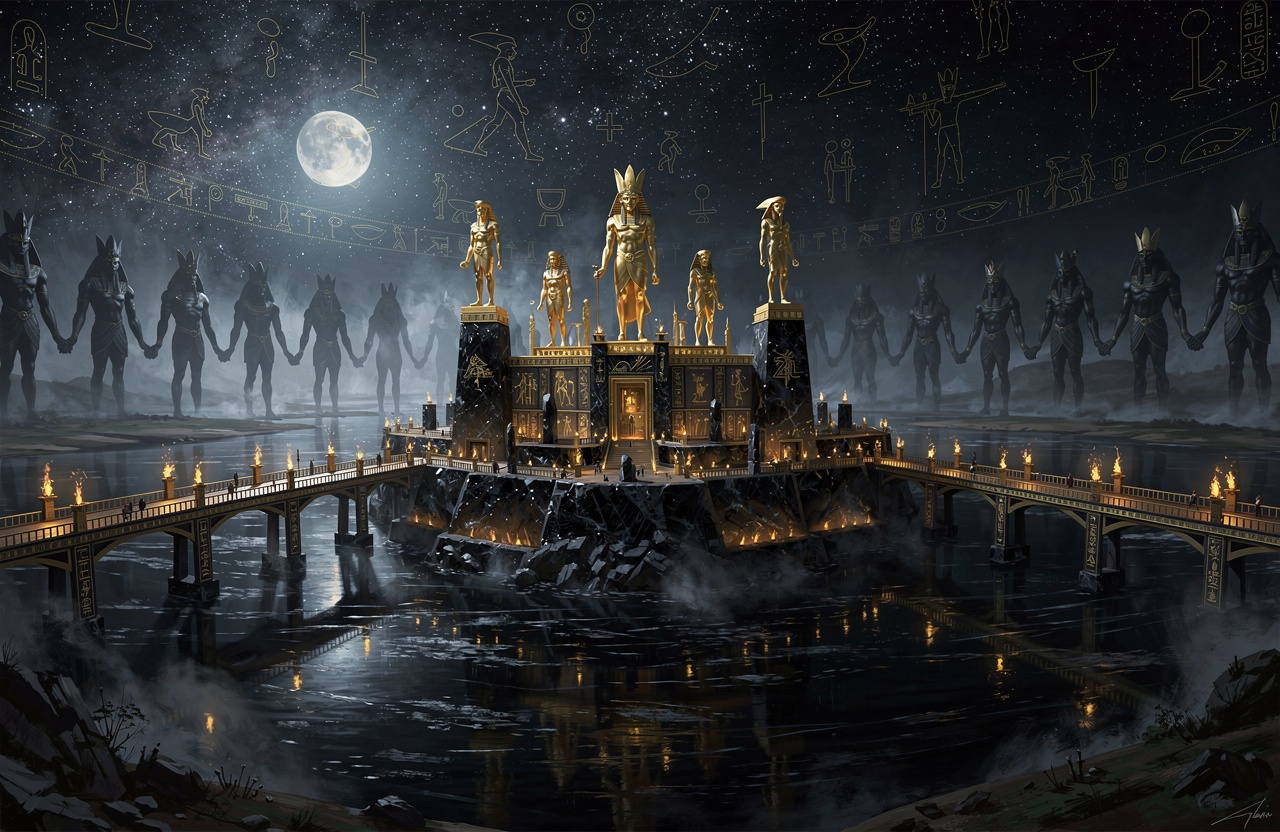
When you picture the Ring — the closed loop of cross-ownership that quietly owns the world — you probably picture Wall Street. BlackRock, Vanguard, a few towers in Manhattan. That's not wrong. But it's incomplete, and the incompleteness matters, because it lets you think of the Ring as American. It isn't. It's a network, and one of its cleanest, most disciplined nodes is a tropical island smaller than New York City.
Singapore runs two enormous state investment vehicles. Temasek Holdings manages a portfolio on the order of hundreds of billions of dollars. GIC — the Government of Singapore Investment Corporation — manages a global portfolio widely estimated in the high hundreds of billions, some estimates north of half a trillion, deliberately never fully disclosed. Together, this single small city-state deploys close to a trillion dollars of sovereign capital into the same global assets the Big Three hold: US tech, global banks, real estate, private equity, semiconductors, the whole board.
Look at that. A country of a few million people is a top-tier global shareholder alongside the largest asset managers on Earth — woven into the exact same web of cross-holdings.
Sovereign capital, same plumbing
Here's what makes the sovereign funds a genuine part of the Ring, and not just big investors standing near it.
They hold the same assets as everyone else in the loop. GIC and Temasek own stakes in the same US tech giants, the same global banks, the same infrastructure and private-equity vehicles that BlackRock, Vanguard, and the Gulf sovereign funds hold. They co-invest alongside the Big Three and the private-equity houses in the same deals. When a mega-buyout or an infrastructure fund gets assembled, you'll often find a Singaporean sovereign fund, a Gulf fund, and a Wall Street giant all in the same syndicate — different flags, same table, same asset.
And the flows run both ways. Temasek has held major stakes in the same financial and tech firms that sit inside the Ring; global asset managers and their funds are woven through the ecosystem Singapore invests in and around. The point isn't a single ownership line you can draw. The point is interlock — a mesh dense enough that "who owns whom" stops being a tree and becomes a web, and the Singaporean node is a load-bearing strand in it.
Add one more feature: opacity. GIC in particular famously does not fully disclose its size or its holdings — officially, to avoid signaling the exact scale of the nation's reserves. Whatever the reason, the effect is the same as everywhere else in the Ring: a very large pool of capital moves through global markets while the full map of what it holds stays behind the curtain.
Why this matters more than it looks
It's tempting to shrug. So a well-run city-state invests its reserves globally — good for them. And Singapore genuinely is well-governed, prosperous, competent. This isn't a story about a villain.
It's a story about shape. Every time another disciplined, well-capitalized sovereign node plugs into the same mesh of cross-holdings, the Ring gets one property stronger: distribution. You can no longer point at Manhattan and say "there's the center." There is no center. There's Wall Street, and the Gulf, and Singapore, and the pension giants, and the Chinese and Norwegian funds — all holding slices of each other and of everything, all co-investing in the same deals, none of them the head, all of them the ring.
That's the whole defensive genius of the structure. A pyramid has an apex you can name, tax, regulate, pressure. A globe-spanning mesh of sovereign and private funds, each holding pieces of the others across a dozen jurisdictions, has no apex and no single jurisdiction with authority over the whole. You can't regulate it from one capital because it doesn't live in one capital. It lives in the links.
Our record
Weigh it on the scale. On one pan: the comfortable frame — a handful of American villains you could theoretically name and constrain. On the other pan: one feather of truth — the Ring is a distributed, multi-flag mesh, and Singapore is one of its most disciplined strands.
This is Apep in its most evolved form. Not a single serpent with one head to sever, but a coil so distributed across nations and flags that severing any one strand leaves the pattern intact. The Egyptians understood their serpent precisely: it was not an enemy you kill once, but a pattern that reassembles. The globalized Ring is that pattern gone planetary — no capital, no regulator, no single people holds authority over the whole, because the whole is the mesh, and the mesh spans every jurisdiction at once. Name any one node and it answers, honestly, that it's only a small sovereign fund minding its reserves. And that's true. The power isn't in the node. It's in the interlock.
Name the shape — distributed, multi-flag, apex-free — and it stops being invisible.
Where the lever is
Do not read this as it's global and headless, so nothing can touch it. Read the myth again: the gods never killed the serpent, and never lost. They met a pattern with a counter-pattern, renewed every single night. That's the instruction.
Stop looking for the head. You will not defeat a distributed mesh by finding its center, because it has none. You defeat a closed, opaque loop the way you always do — by building an open one beside it. Legible ownership. Transparent treasuries. Structures where "who holds what" is public by construction and there's nowhere for the interlock to hide.
Value transparency as the actual battleground. The sovereign funds' strength is opacity — undisclosed size, undisclosed holdings, positions behind a curtain. The counter-force is radical transparency. On-chain treasuries, public reserves, ownership anyone can audit. Every asset held in the open is one strand pulled out of the dark mesh and rewoven into Maat.
Go local against the global. A planet-spanning mesh has no answer to genuinely rooted, member-owned local structures — cooperatives, community-held assets, DAOs where the members are the owners and the vote is the ownership. You can't out-scale the Ring. You can out-root it.
Diversify the systems, not just the flags. The Ring already spans every flag. Adding one more national fund doesn't escape it — it joins it. Escape is a different kind of structure: open where it is closed, legible where it is opaque, member-held where it is fund-held.
Singapore's funds are not villains, and the mesh has no head. Good — then stop hunting for one. Build the open ring, hold your own strand in the light, and let the closed coil circle only itself.
Balance the scale. Root what the Ring can only network.