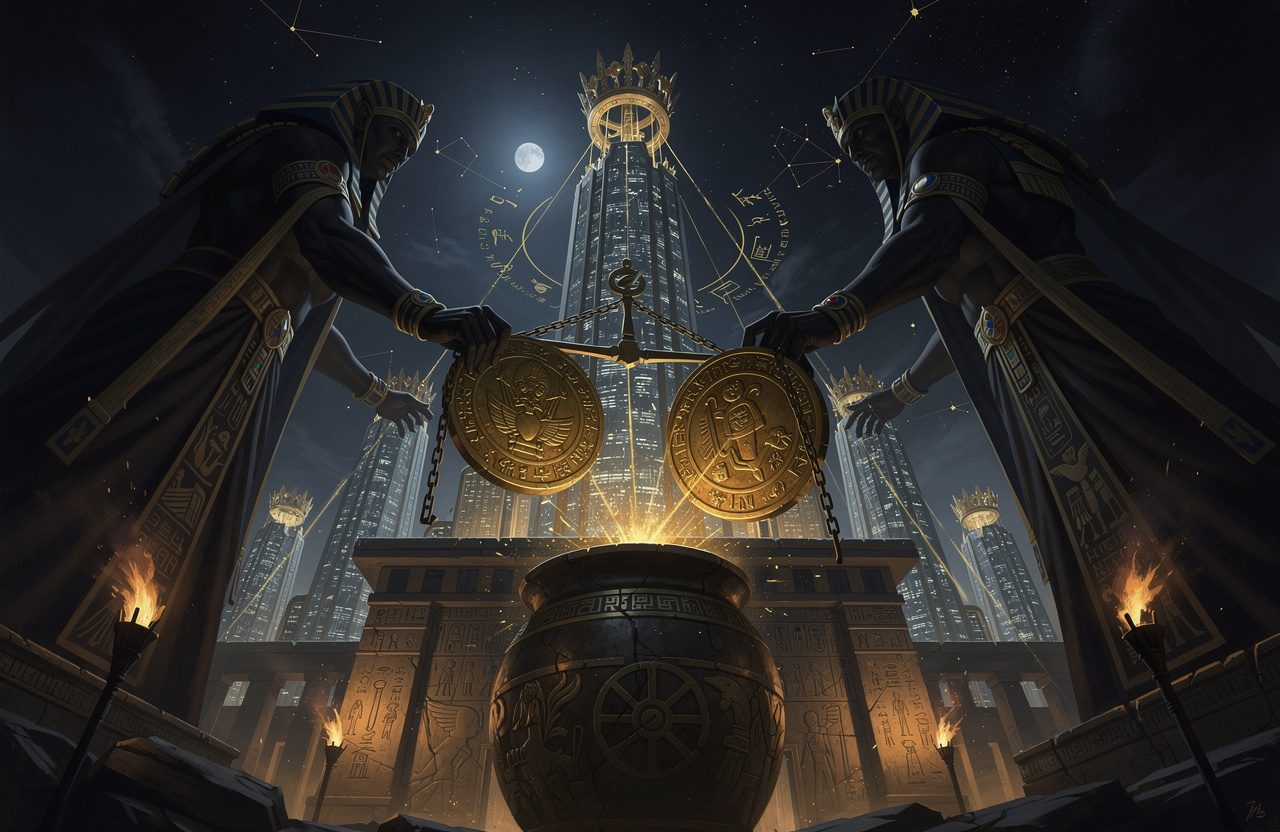
When people talk about the power of the Big Three, they usually picture chests of money. But money is only half of it. The real power is the vote. The right to raise your hand at a shareholder meeting and say: appoint this director, approve this bonus, adopt this strategy. And that vote is held for you by BlackRock, Vanguard, and State Street. Let's take apart the mechanics, the way you'd read someone else's code.
Whoever owns, votes
A share is not just a slice of profit. It is also a vote. One of the main ways a corporation makes decisions is the shareholder meeting: every holder votes in proportion to their stake. Hold 7%, and you have 7% of the votes.
Now add up what we already know. BlackRock holds around 7% of a typical large company, Vanguard about 6%, State Street about 4%. Together, 15–25% of the votes in nearly every major company in the Western world. At an ordinary meeting, where the other shareholders are scattered and often don't vote at all, a bloc of 15–25% is enough to decide almost any question. Even if everyone else is against.
That is power, not just wealth. A rich man can buy a yacht. The three can appoint the boards of corporations that employ millions.
The vote that isn't yours
Here is the point most people miss. When you put money into a fund — through a pension, an ETF, insurance — you become a client. And a client hands the voting right to the manager. On shares bought with your money, BlackRock votes, not you.
Think about it: your money sits in Apple, in Exxon, in pharma. Formally you co-own half the major companies on the planet. But at the meeting the fund wields those votes. Your vote technically exists, but it is not in your hands. An intermediary you never chose, whose decisions you never see, holds it.
It's like buying a server and handing root access to the host. The machine is yours, the bill is yours, but a stranger types the commands — and, as a rule, not in your favor.
The invisible link: ISS and Glass Lewis
Now comes the part almost no one has heard of. Voting across thousands of companies is enormous work, and keeping a staff of analysts who study every meeting is expensive.
So the funds offloaded it onto two quiet intermediaries — the firms ISS and Glass Lewis. These two study every question at every meeting and write a recommendation: "vote for," "vote against." They send it to their fund clients. And the funds, in most cases, vote exactly as ISS and Glass Lewis told them. Not because they must — simply because thinking for themselves would be expensive.
The result is a strange picture. In reality, BlackRock and Vanguard don't vote directly. Two small advisory firms vote. The three are the obedient executors of the recommendation. The book calls them weathervanes: not gods, they look at which way the wind blows and write their advice. This is the narrow bottleneck of the whole system — and, as we'll see, its weak point.
The parable of 0.02%
In 2021 something happened that shows how this works better than any textbook. There was an oil giant, ExxonMobil — market cap around 250 billion dollars, a board of twelve, immovable, century-old, golden.
And a tiny fund appeared, Engine No. 1 — a team of twelve, about 250 million under management. In Exxon's terms that's 0.02% of the shares. Two-hundredths of a percent. Dust. A rounding error in BlackRock's spreadsheet. They argued: this company isn't preparing for the energy transition, it will destroy shareholder value, let's replace some directors.
Exxon's board replied, in effect, "you have 0.02%, good luck." The vote was held on 26 May 2021. And Engine No. 1 took three of the twelve seats on the board of an oil giant.
How? They didn't buy more shares — they had 0.02% before and after. They did something else: they framed a clear financial argument, convinced ISS and Glass Lewis, and went to the big pension funds (CalPERS, CalSTRS, New York State Common): "you hold Exxon, you have a duty to your beneficiaries, vote with us." The advisors backed some candidates — and then came the avalanche. With the votes of BlackRock, Vanguard, and State Street, which followed the recommendation, three directors got through.
The lesson any IT director grasps instantly: you don't need to own much — you need to coordinate those who already do. Coordination beats size.
Where is the ordinary person here
Nowhere — and that's the whole trick. Your vote was collected, packaged, handed to a fund, the fund offloaded the decision onto ISS, and you never even knew. You are the source of the voting right, but not its bearer. The chain is built so that as many intermediaries as possible stand between your money and the actual decision, each taking a sliver of control.
But the Engine No. 1 story said out loud what is usually hidden: this whole machine moves on coordination, not size. Which means it can be turned around.
What to do about it: the MAAT token and DAO
Engine No. 1 did it once, for one company. Now imagine a mechanism that does it constantly and across a broad front: not twelve activists, but millions of people with a shared token and a shared treasury, voting as a single bloc.
That is MAAT. The MAAT token is membership in a cooperative and a single vote. Not "one dollar, one vote" like the funds, but one human, one vote. Decisions are made in a DAO — a decentralized organization with a transparent treasury where every movement of funds and every vote is visible. People in different countries can't gather in one office — but they can vote through an app, and their combined vote lands as a single bloc at the shareholder meeting of Apple or Exxon. Coordination without an intermediary, a treasury without a banker, a vote without a broker.
The three hold your votes precisely because you are scattered, and ISS and Glass Lewis are the bottleneck that listens to whoever is organized. MAAT is an attempt to become the organized side. The entry is simple: read the book, take the token, get your vote — and for the first time in your life, cast it yourself.