You paid for that road twice. Once with your taxes, when the public built it. And now again, every time you drive it, because somewhere along the way the public leased it — for decades, sometimes for a century — to a fund that now charges you to use the thing you already own. The asphalt didn't change. The bill did.
There is a quiet revolution in who owns the ground beneath your tires, and almost no one voted on it. Highways, bridges, tunnels, airports, parking meters — the boring, unglamorous plumbing of daily movement — have become one of the hottest asset classes on Earth. Not because they're exciting. Because they're a toll booth on a road you cannot avoid. And the smartest, most patient money in the world figured that out a long time ago.
The bank that owns the roads
There is a name you should know: Macquarie. An Australian financial group, sometimes nicknamed "the millionaires' factory," that pioneered turning infrastructure into a fund product on a global scale. Through its infrastructure arms, Macquarie has held stakes in toll roads, airports, utilities, and other essential assets across dozens of countries — hundreds of billions of dollars in assets under management pointed at the physical world people cannot avoid.
The model spread. Today the giants of private capital all run huge infrastructure funds — Brookfield, KKR, Blackstone, and yes, the index colossus BlackRock, which built a massive infrastructure business by acquiring Global Infrastructure Partners in a deal on the order of tens of billions of dollars. Sovereign wealth funds and pension funds pile in alongside them. And the target is always the same shape: a monopoly asset with captive demand and inflation-linked pricing. A road with no parallel. A bridge with no alternative. A tunnel that is the only way through.
Here is how the trade works. A government is short on cash. A fund offers a large upfront payment for a long-term lease on a public road — thirty, fifty, ninety-nine years. The politician gets a headline number to fix this year's budget. The fund gets decades of toll revenue, usually with contractual rights to raise the toll every single year, often faster than inflation. The public gets a road it built, now metered, priced by an owner on the far side of the world whose only relationship to that road is the cash it throws off.
Rent on the act of moving
Understand why a road is such a perfect asset, and you understand the whole enclosure.
Movement is not optional. You have to get to work. The truck has to make the delivery. The ambulance has to reach the hospital. A road that is the practical only route has vertical demand — the same brutal economics as water and ports. The customer cannot walk away, because walking away means not showing up to the job that feeds the family. So the toll can climb, year after contractual year, and the traffic still comes. That is not a service. That is a levy on the act of moving through space.
And like every good chokepoint, it hides. The toll feels like a small transaction, a few dollars, a beep of the transponder. But multiply it across every commuter, every truck, every day, across a lease that runs longer than your working life, and it becomes a river of rent flowing uphill to a fund. The upfront payment the government took looks generous for one budget cycle. Measured against the total tolls extracted over ninety-nine years, it is almost always a fire sale — the public trading a permanent income stream for a one-time patch.
The genius is the time horizon. Politicians think in election cycles. Funds think in decades. When one side optimizes for the next four years and the other side optimizes for the next four generations, the funds win the trade every time, at the public's expense — and the public rarely notices, because the loss is spread thin across a lifetime of small beeps at the toll gantry.
Our Record
The road is one of civilization's oldest commons. In old Egypt, the processional ways, the river routes, the paths the goods and the pilgrims moved along were the shared arteries of the land — kept open by the crown as a duty, because a kingdom whose roads were blocked was a kingdom that could not breathe. To move freely along the ways was part of Ma'at: the order that let life circulate.
Now weigh what the lease does. It takes a common artery — a thing built by all, for all, to let life flow — and installs a gate on it, held by an owner whose duty is not to the land but to the yield. Every passage becomes a payment. Every journey feeds the fund a little more Sekhem. The Shadow Neteru learned that you don't need to own where people are going. You need only own the way between here and there, and charge them for the crossing.
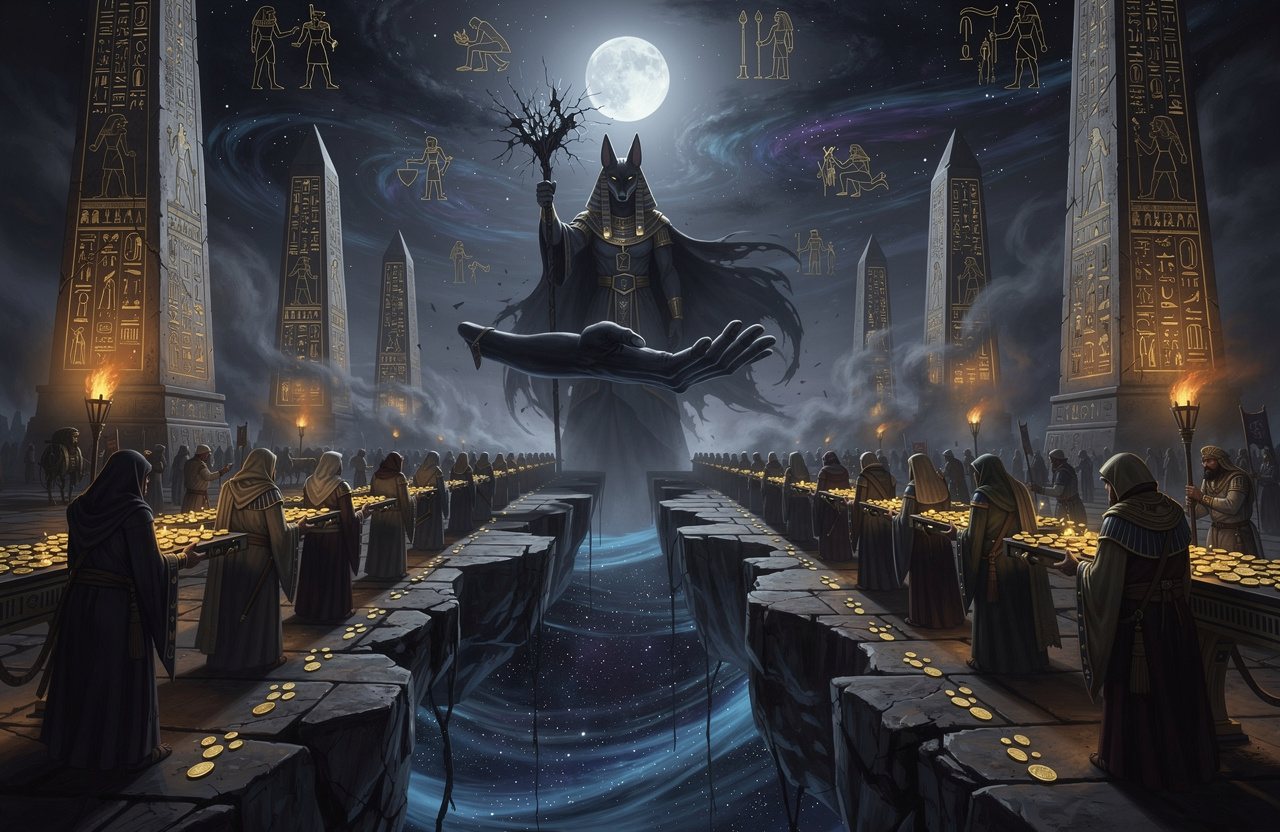
This is Apep as the tollman on the bridge of the dead — except the bridge is your morning commute, and the toll is forever. Isfet here is not chaos on the road. It is the slow, lawful, contractual bleeding of the commons into private rent, one transponder beep at a time.
The lever: leases end, and the ground stays
Never doom without a door. The door here is unusually strong, because a road is the most physical, most local, most publicly-rooted asset there is — and the trade that privatized it was a political choice, not a law of nature.
First, leases are contracts, and contracts have terms — and can be scrutinized, renegotiated, and refused. A privatization deal is only as permanent as the public's willingness to keep signing them. Stop signing. Demand that essential infrastructure stays in public or cooperative hands, and defend it at the level of government where accountability is closest to the voter.
Second, the road never physically moves. Unlike a stock, it cannot flee to a tax haven. It sits in your jurisdiction, under your community's feet, answerable in principle to your law. That rootedness is leverage the Ring can never fully escape.
So the levers: keep strategic transport public. Where infrastructure must be funded privately, structure it as a cooperative or a public trust — collective ownership that returns the toll to the community that drives on it, not to a distant fund. And use the new tools — transparent public ledgers, open contracts anyone can audit — so that the true lifetime value of a ninety-nine-year lease is visible before a politician signs away four generations for one budget cycle.
The fund wants the road because you cannot avoid the road. So own the road together, in the open, priced for passage instead of yield. What everyone must travel, no one should privately tax. Keep the way clear.