Reach into your pocket. That warm slab of glass is not a tool you own. It is a sense-organ, and the body it belongs to is not yours.
You bought it. You paid full price. You believe it works for you — it takes your calls, holds your photos, plays your music. And it does all of that, faithfully, while doing something else in the background you never explicitly asked for: it reports. Where you are. What you hear. What you buy. Who you're near. It is the most intimate listening post ever mass-deployed, and it went into a billion pockets willingly, sold as a convenience.
The old Panopticon needed a tower and a guard. This one needed a charging cable and a Terms of Service you didn't read.
The Three Nerves
A phone senses you through three channels, and each one was normalized so gradually you never felt the boundary cross.
Location. Your phone knows where you are to within a few meters, continuously, and it does not need GPS to do it — cell tower triangulation, Wi-Fi network fingerprinting, and Bluetooth beacons keep the fix alive even with "location services" nominally off. That stream doesn't just sit on the device. Apps harvest it. In 2018 investigations showed dozens of ordinary apps — weather, flashlights, games — quietly selling precise location data to brokers, some updating your coordinates thousands of times a day. Your movement is a product with a price sheet.
Microphone. You don't need a phone that "always listens" for the mic to matter — though "Hey Siri" and "OK Google" mean a wake-word engine is, by design, sampling audio constantly, waiting. The paranoia about ads that follow a spoken conversation is mostly explained by something more mundane and more total: the system doesn't need to hear you when it already knows your location, your contacts, your searches, and the person you just stood next to. It infers the conversation from the metadata. That's worse, not better.
Purchases. Every tap-to-pay, every card linked to your wallet, every in-app buy is a data point about what you consume, when, where, and how much. Fused with location, it becomes a map of your desires and dependencies — the coffee you can't skip, the pharmacy you visit, the bar you close down. Consumption is confession, and the phone takes dictation.
Three nerves. Together they don't describe what you do. They predict what you'll do next.
The Wedjat as a Subscription
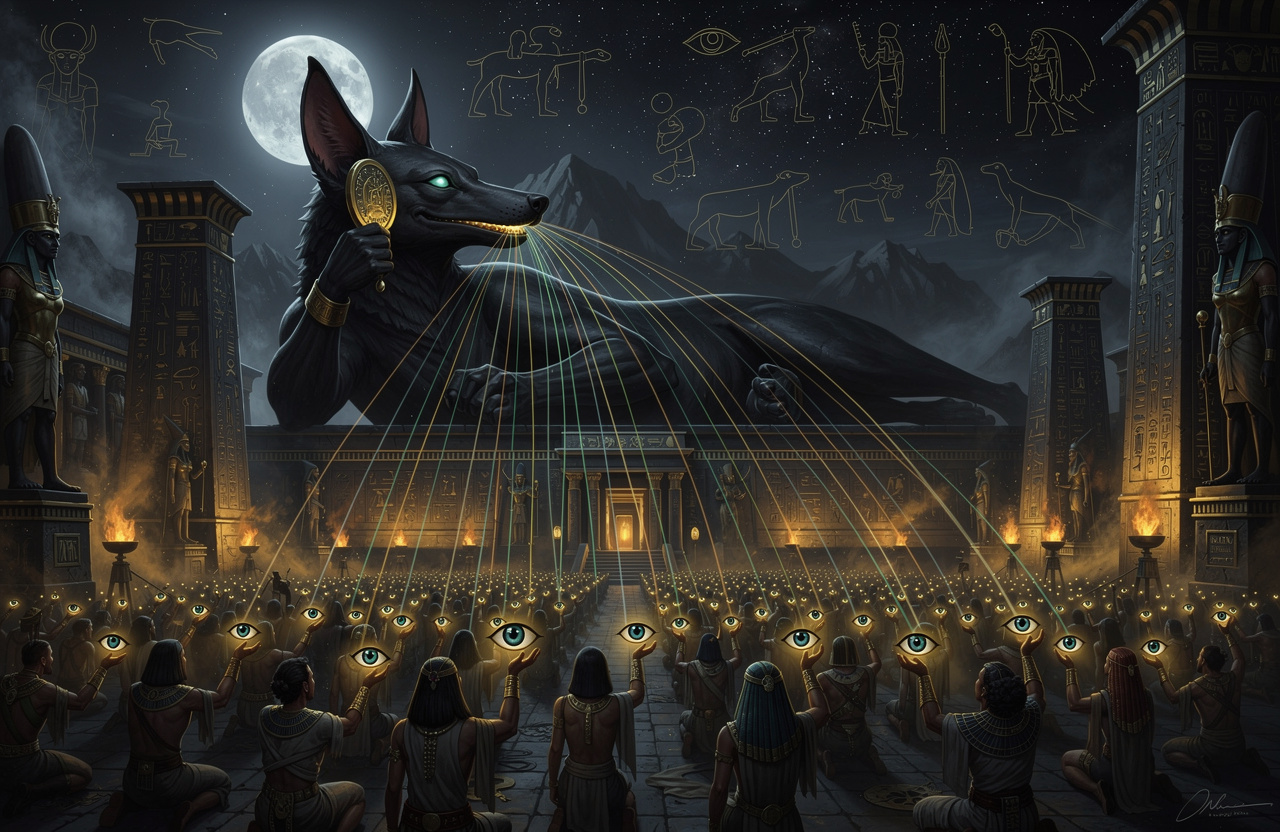
For millennia the Eye of Horus — the Wedjat — was the symbol of complete, all-seeing vision: sight made whole, protection and, in the wrong hands, total watching. It was a carving. A prayer on a temple wall. A metaphor for a power no mortal actually held.
Now the eye ships. It runs on a battery. It rides in your pocket, and — here is the reversal that should chill you — you carry it there voluntarily and you recharge it every night. The all-seeing eye no longer belongs to a distant god or a distant state. It belongs to a handful of platforms, and it is rented to you as a feature. You pay for the privilege of being the sensor. The subscription model of surveillance: you supply the device, the power, the movement, and the data — and they supply the convenience that keeps you carrying it.
The genius of it is that there is no tower. The watched population built the panopticon out of its own pockets.
Our Record
Our record: the Shadow Neteru's oldest hunger was never to punish — it was to see. To perceive the intention before the deed, to read the Ba while it still forms the wish. For thousands of years that hunger was starved by simple friction: a body could only be in one place, seen by one pair of eyes, remembered imperfectly. The phone dissolved the friction. It gave the watching power a nervous system that reaches into every pocket at once, sensing millions of Ba in parallel, in real time, and never forgetting. In the weighing of Ma'at the heart is examined once, in the open, against a feather, with the outcome visible. The phone inverts every term: the weighing is constant, secret, and the scale is proprietary. That inversion — sight without consent, memory without mercy — is the signature of Isfet wearing the mask of a smartphone.
Why "It's Just Convenience" Is the Trap
The defense is always the same, and it's clean: nobody forces you. You want the map that knows where you are. You want the assistant that hears "call mom." The tracking is the price of the magic, and the magic is real. Where's the harm?
Here's the harm, and it's a change of kind, not degree. Convenience purchased with continuous telemetry doesn't stay a convenience — it becomes a dependency, and dependency becomes a leash. Each feature is defensible alone. Fused, they compose a dossier no secret police in history could have assembled: a minute-by-minute record of your body, your habits, your relationships, and your weaknesses, sitting on servers you'll never see, feeding models trained to predict and nudge you. The scatter of your life across separate acts used to be a protection. The phone fuses the scatter into one profile, and the fusion is the whole point. "Convenience" is the word that smuggles in a change of kind while pretending it's only a matter of taste.
And a sense-organ doesn't just sense. It feeds a brain that acts. Once the system knows you this well, it stops merely observing and starts steering — which ad, which price, which feed, which nudge. You are no longer the customer. You are the terrain.
The Lever
Don't despair at the eye in your pocket. Understand its weakness — because a sensor you carry is a sensor you can starve.
Your levers are concrete, and most cost nothing but attention. Kill background location for every app that has no earthly reason to know where you are — the flashlight does not need your coordinates. Audit app permissions like you audit a bank statement: revoke by default, grant by exception. Turn off the ad identifier; use a browser that blocks trackers; prefer apps that don't phone home. Where you can, run local-first tools that keep your data on the device instead of streaming it to a vendor's brain. Pay with cash sometimes, on purpose — a purchase with no digital trail is one dot the lens can't fuse. And use encrypted messaging where the platform can't read the contents, so the metadata is all they get and the words stay yours.
The eye is powerful because it is fed. Every permission you deny, every default you switch off, every night you leave the location toggle dark is one less nerve reporting home. You cannot make the eye blind. You can make it hungry.
Carry the glass. Just don't let it carry you.