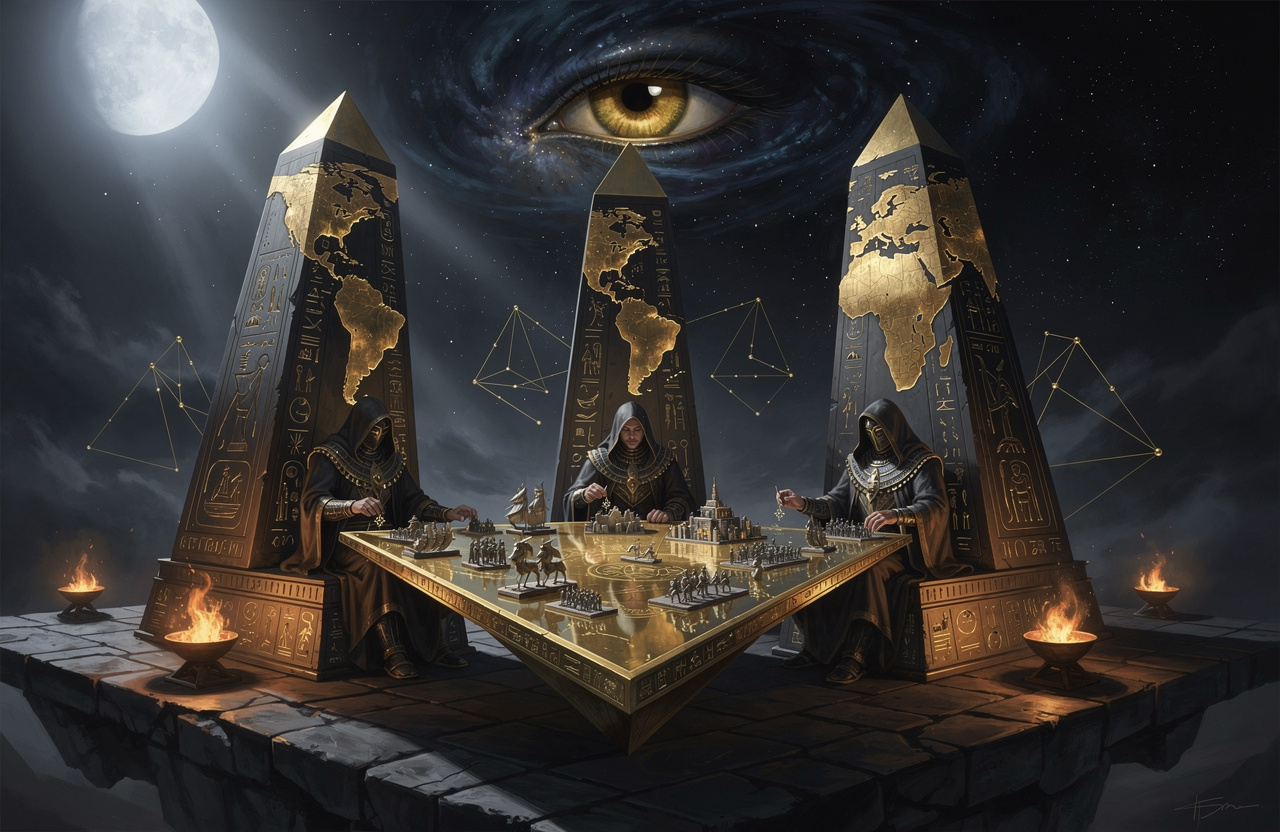
Once a year, in an expensive hotel somewhere in Europe, about a hundred and fifty people gather: prime ministers and ex-prime ministers, heads of banks and corporations, newspaper editors, princes, generals. A guarded perimeter, no press allowed, no minutes published. This is the Bilderberg group. Alongside it sits the Trilateral Commission, joining the elites of three power centers: North America, Europe, and Japan (and now, more broadly, Asia). And here's the fun part: so many myths are piled around these meetings that they almost hide a much simpler and far more unpleasant truth.
What it is and where it came from
Bilderberg began in 1954 — an informal annual conference of Western elites, named after the Dutch hotel where the first meeting was held. The Trilateral Commission was founded in 1973 by David Rockefeller with Zbigniew Brzezinski, to coordinate the policy of the developed industrial regions. Both structures are private, closed to the public, and deliberately informal: no laws are passed there and no treaties are signed.
And that's the first thing to grasp so you don't look like a fool. Fact: these clubs genuinely exist, genuinely gather the planet's most influential people, and genuinely do it behind closed doors. Myth: that inside the hall they vote a world government into being, appoint presidents, and itemize future wars. There's no "world parliament" in the hotel. But the absence of a parliament doesn't mean the absence of power — the power here is simply of a different kind.
Why coordinate at all
Back to the simple engineering idea running through this whole series: pooled capital works incomparably more powerfully than scattered capital. As long as players compete one by one, they're weaker than they could be together. This was true for one family's five banks sent to the capitals, and it's true for the elites of different countries.
The problem is that the elites of different states are formally rivals. Their countries compete, sometimes go to war. They need a venue where, without breaching public decorum, they can sync their watches: check which way the wind is blowing, agree on the frame everyone will act within, introduce "their" young to "their" old. Bilderberg and the Trilateral are exactly such venues. Not a headquarters of orders, but an environment of alignment.
Power without a signature
Here's the subtlety. For coordination to work, it needs no minutes and no resolutions. It's enough that a hundred and fifty of the most influential people leave the hotel with the same sense of what is now "reasonable," what is "inevitable," and what is "untimely." Then each returns to his place — in government, at a bank, in an editorial office — and acts on that shared frame. On his own. Without an order. Sincerely believing it to be his own considered judgment.
It's the same factory of "common sense" as the think tanks, only in its most concentrated form and with no paper trail. The secrecy isn't there to hide a plot but to let people speak frankly, without an eye on voters and cameras — and leave already agreed on the tone. And the lack of minutes isn't evidence, it's a feature: what isn't written down can't be produced.
Where the pattern is
Read through the book's blueprint, a familiar picture emerges. Power rests on three things: control of meaning, control of resource, and the interface figure that presents it all as legitimacy. In one Bilderberg room you find carriers of all three at once: those who own the money; those who shape meaning (editors, experts); and those who serve as the interface (politicians). It's not a conspiracy of individuals — it's the place where all three modules of the old control protocol converge and, for a couple of days, come into direct contact.
And here it's worth repeating the book's own honest caveat: there's no secret council of families at the top ruling everything. Most participants are real specialists, and they aren't weaving a plot. But coordination happens anyway — not as collusion from a list, but as the natural drawing-together of people of one circle, one set of interests, one language. And that's enough. The protocol needs no headquarters. It needs an environment.
Where the ordinary person stands
Beyond the guarded perimeter. He isn't invited and won't be, because the venue's entire value is its closedness. The decisions that ripen there as "shared understanding" reach him already finished and presented as objective necessity: that's how the economy works, that's geopolitics, there's no other way. He wasn't asked — and there was never any intention to ask. He's left the role of one who lives inside a frame agreed without him and above him.
The answer: the MAAT token and DAO
The strength of these clubs is not secrecy but coordination: a handful of people sync up and therefore act as a single body against millions who are unsynchronized. That's precisely the move that has worked against the ordinary person for centuries: they're together, we're alone. So the answer is symmetric — ordinary people need their own venue for coordination. Only not a closed one, an open one.
That is MAAT. The MAAT token is membership in a cooperative that does for millions what Bilderberg does for a hundred: it gives a place to align a position and act together. But it's built the other way around: instead of a guarded hotel, a DAO — a decentralized organization with no perimeter; instead of private minutes, a transparent treasury where every movement of funds is visible; instead of "by invitation," entry by membership. And the vote here comes not from the weight of a wallet but from the person himself: one human, one vote, not "one dollar, one vote." They coordinate behind closed doors to decide for you. We coordinate in the open to decide for ourselves. The entry is simple: read the book, take the token, get your vote — and end up on the other side of the perimeter, where people sync up not against you, but with you.