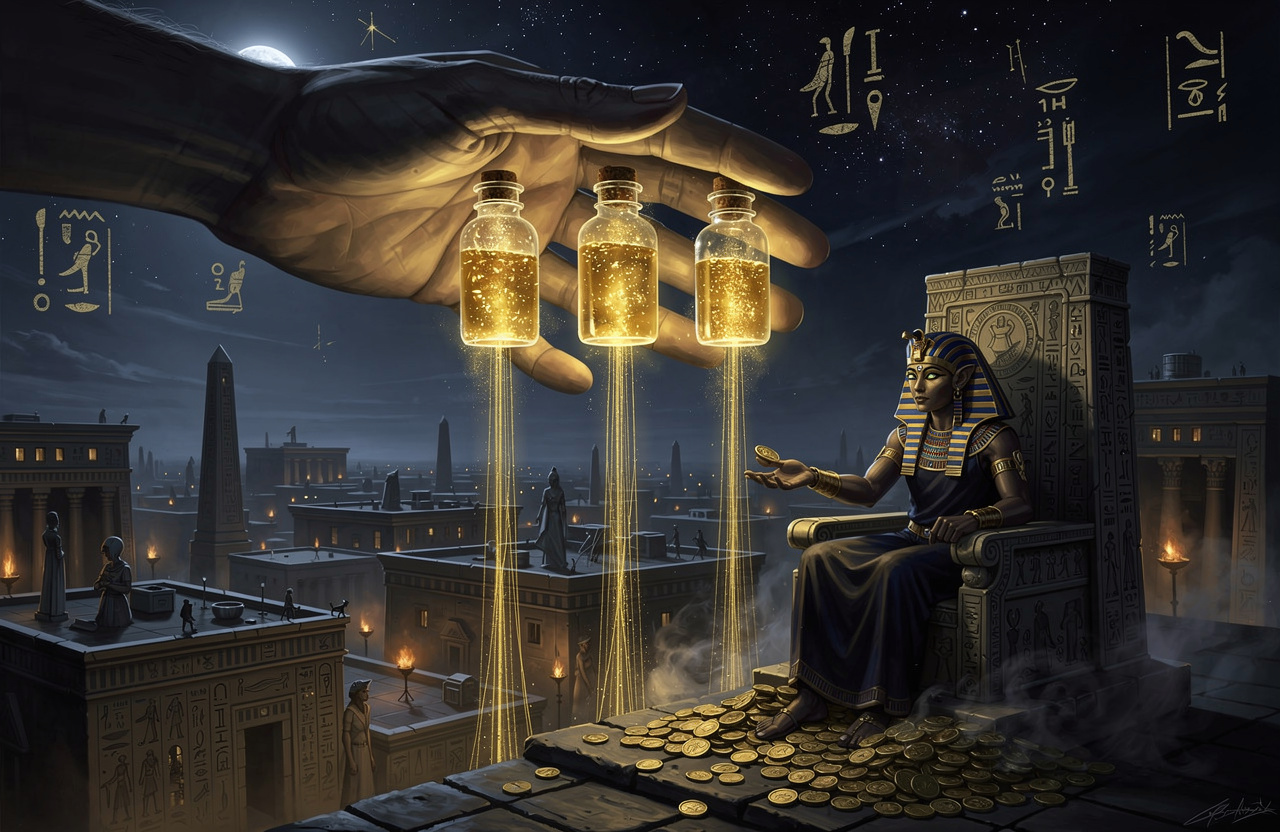
Pick your vaccine. Go on. Pfizer or Moderna. Johnson & Johnson if you liked the one-shot. You stood in line, you rolled up your sleeve, you made a choice. You felt like a consumer with agency.
Now look at the cap table. Behind Pfizer's largest institutional block sits Vanguard. Behind Moderna's — Vanguard. Behind Johnson & Johnson's — Vanguard. The same fund, near the top of the register, on all three. And right beside it, on all three again: BlackRock. State Street a step behind.
You had a choice of needle. You never had a choice of owner.
The number you weren't shown
Vanguard and BlackRock each hold on the order of 7–9% of the big pharma names. Individually that already makes each one the largest or near-largest shareholder. Together the "Big Three" — Vanguard, BlackRock, State Street — routinely command 15–20% or more of a large-cap US company's stock, and they hold that same slice across the whole sector at once.
So do the arithmetic the marketing never wanted you to do. Pfizer's shot succeeds — the owner wins. Moderna's mRNA platform eats Pfizer's market share — the same owner wins. J&J's one-dose gambit flops — the owner already collected on the other two. There is no outcome in the vaccine race where the top of the register loses. The horses change. The stable does not.
This is not a conspiracy. It's a structure. Index funds buy the whole sector by mandate — that's what an index is. The moment healthcare became a category you could buy as a basket, the top shareholders of every rival inside that basket became the same handful of institutions. Competition on the shelf. Common ownership above it.
What common ownership quietly does
Here's the part economists have been publishing on for a decade, and nobody put on the evening news. When one owner sits atop several competitors in a market, that owner has no interest in a price war between them. A price war transfers money from one of your holdings to another and shrinks the pie for both. The owner would rather the pie stay fat and stable.
You don't need a smoke-filled room for this. You don't need a phone call. The incentive is baked into the ownership itself. Management teams that "compete too hard" — that cut prices, that erode margins to win share — are simply not the ones a diversified mega-owner rewards. The pressure runs one way: toward pricing power, toward margin, toward the whole sector rising together.
Look at US drug prices against the rest of the developed world. Look at how rarely a genuine price war breaks out in a concentrated pharma category. Then look at who owns all the players. The picture assembles itself.
Our record
On the Scales of Maat we log this plainly. A Ring is any structure where the many appear to compete while the few above them are unified — where your visible choice feeds a single invisible owner. Pharma is a clean specimen. Three brands. One register. Isfet doesn't hate your choice; Isfet feeds on it. Every "which one do I pick" keeps your eyes on the shelf and off the ledger.
Apep, the old serpent of entropy, does not fight you head-on. It coils. It arranges the board so that all roads route Sekhem — life-force, energy, the vitality you spend on your health — back to the same coil. You think you're moving. You're circling.
Name it, and it loses power. That's the whole trick. A Ring runs on you not seeing it as a ring.
"But someone has to own the shares"
True. Capital has to sit somewhere. The problem isn't that Vanguard exists — it's concentration plus opacity plus your absence. You are the underlying capital in most of these funds. It's your pension, your 401(k), your index ETF feeding Vanguard's roughly 8 trillion and BlackRock's 10-plus trillion in assets. You own the ring. You just don't hold the keys.
That's the legacy bug in the whole system. Ownership got abstracted so many layers up that the actual owners — you — lost the ability to vote, to steer, to even see what you own. The proxy votes get cast by the fund. The influence over management gets exercised by the fund. You get the price movement and a quarterly statement. Not your keys, not your coins — except here it's not your coins, and it's your health, your food, your grid, all voted on by proxy without you in the room.
The lever
Don't despair. Map it. A ring you can see is a ring you can route around.
See the register, not the label. Next time a "choice" is marketed to you — brands, products, even political parties — ask one question: who sits at the top of all of them at once? If it's the same three names, you're inside a ring, and the choice is theater.
Move Sekhem to structures you actually hold. The whole point of decentralization, of a cooperative, of a DAO, of self-custodied crypto, of open-source AI — is ownership that doesn't abstract you out of the loop. A cap table you can read. A vote you actually cast. Value that doesn't route back to a coil above you.
Support what the ring can't buy. Independent producers. Open protocols. Anything where the owner and the user are the same person — you. The Big Three can own every listed rival in a sector. They cannot own a structure that was never issued as a share for them to accumulate.
You don't beat a ring by picking the "right" brand inside it. You beat it by owning the layer above the brands — or building a system that has no coil at the top.
Pick your vaccine. Fine. Then lift your eyes from the shelf and read the register. Once you've seen the owner behind all three doors, the game is already different — because now you're playing it, instead of being played by it.
Name the ring. Own your keys. Route your force to what you hold.