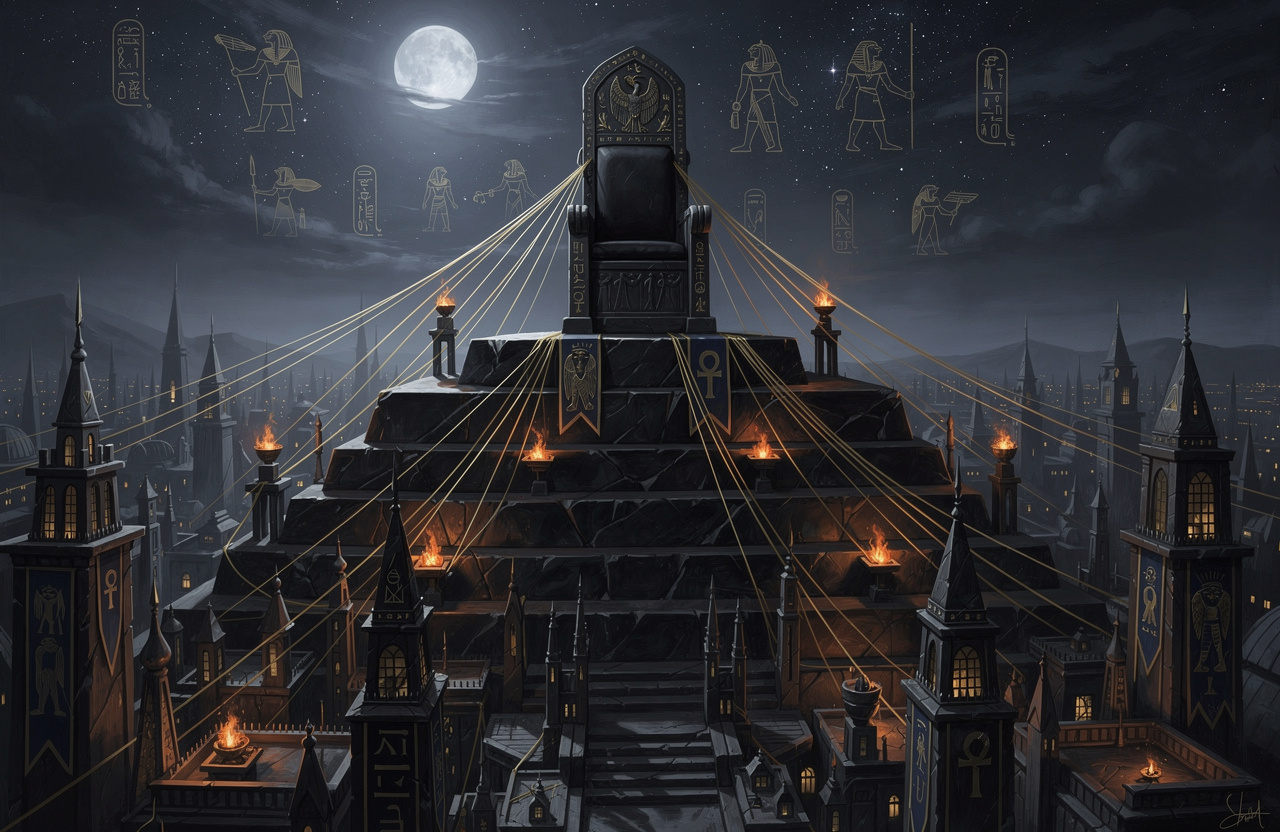
There is a company that steers on the order of nine trillion dollars, sits atop thousands of the world's corporations — and belongs to no one.
Not "belongs to a secretive family." Not "belongs to a foreign fund." No one. Vanguard is legally structured so that it is owned by its own funds — and the funds are owned by their investors. Trace the ownership up and it doesn't arrive at a person, a family, a holding company, a state. It arrives at a legal mirror pointing back down at the thing you started with. Vanguard owns the funds; the funds own Vanguard. The chain closes into a loop, and the loop has no clasp.
Most people's instinct, hearing this, is relief. No greedy billionaire at the top? No dynasty pulling strings? Sounds almost democratic. Sit with it a moment longer. The absence of an owner is not the absence of power. It is power that cannot be held to account.
The Difference Between a Tyrant and a Ghost
A tyrant has a body. That is his fatal flaw, and history knows it well. A single master can be named, and a name can be summoned. He can be taxed, sued, exposed, deposed, buried. His interests are visible — you can see what he wants, and being a mortal thing, he can be resisted, negotiated with, or outlived. Every despot in history had one shared weakness: he existed at a location, and existence can be confronted.
A ghost has no location. Vanguard-as-structure is a ghost. It exercises enormous power — voting shares across the entire market, shaping boards, steering capital — but there is no one who exercises it, no throat behind the voice, no hand you can trace the strings back to. Ask "who decided?" and every answer dissolves: the funds decided, the structure decided, the mandate decided, the index decided. Point at the source of the power and your finger passes straight through. Power with a face can be judged. Power without a face just acts — and walks away before the question forms.
We were trained to fear the wrong monster. We watch for the villain at the top of the pyramid. But the most concentrated power of our age does not sit at an apex. It circulates through a structure with no apex at all — and that is precisely why it is so hard to name, so impossible to indict, so smooth to obey.
Our Record
Our record: the deepest law of Ma'at is that every heart is weighed. The soul stands before the scale, alone, named, and answers for itself. Judgment requires a self to judge — a Ba that can be summoned, a face that can be seen, a heart that can be laid on the pan against the feather. This is the whole architecture of justice: an author who answers. The ownerless structure is the perfect escape from that law. It has diffused the self out of existence. There is nothing to summon to the scale — no heart, no face, no Ba — only a legal weather system that produces effects without an actor. Isfet's masterstroke is not to build a monster too strong to defeat. It is to build a power with no self to weigh — an act with no author, a will with no one to hold responsible. You cannot judge a ghost. That is the point of becoming one.
Why "No Owner" Concentrates, Not Distributes
Here is the sleight of hand, and it is elegant.
"Owned by its investors" sounds like power spread thin — millions of ordinary savers, each holding a sliver. But ownership and control are different things. The millions of investors own the economic upside; they collect the returns. They do not run the machine. They do not cast the votes. When Vanguard holds a huge stake in a corporation and votes those shares, it is not polling its millions of investors on each decision. A small internal apparatus votes on behalf of the whole diffuse mass. The money is distributed. The control is concentrated — in a body that answers to no owner, because there is no owner to answer to.
Read that carefully. This is worse than a single master, not better. A single master at least owns his power and can be made to answer for it. Here the power is severed from ownership entirely: those who hold the shares don't control them, and those who control the shares don't own them — and above them both, there is no owner at all. Responsibility has been engineered out of the structure. It is control without ownership, sitting atop ownership without control, capped by a loop with no owner. Three layers of "not me." A machine that runs the economy and, when asked who is driving, honestly answers: no one.
That is not the softening of power. It is its perfection — power that has finally shed the one liability every emperor carried: a self that could be called to the scale.
The Lever
Do not let the ghost win by making you feel there is no one to fight. That feeling is the weapon. The whole power of a faceless structure comes from the sense that it cannot be gripped — so refuse the frame that a monster must have a face to be opposed.
You do not fight a ghost by hunting for its body. You fight it by building structures that cannot become ghosts — where ownership, control, and accountability are welded back together instead of severed apart.
That is not a slogan. It is a design. In a real cooperative, the people who own it are the people who govern it, and every vote has a name attached. In transparent on-chain governance, the ledger is public, the vote is yours, and there is no proxy quietly casting it "on your behalf." In a DAO built honestly, control is not a mystery apparatus — it is a right each holder exercises directly, visibly, on the record. The counter-structure to the ownerless ghost is the fully-owned, fully-legible commons — where the self that acts is the same self that answers.
The deepest thing the old ledger of Ma'at insists on is this: every act must have an author who answers for it. The ownerless structure is the total repudiation of that law. Your task is not to find the man behind Vanguard — there isn't one. Your task is to refuse to build your own future inside a structure engineered so no one is ever responsible.
Weld the self back onto the act. Own what you own. Vote what you vote. Stand where you can be named — and build only with others willing to stand there too.
A ghost cannot be judged. So stop chasing it, and become impossible to haunt.