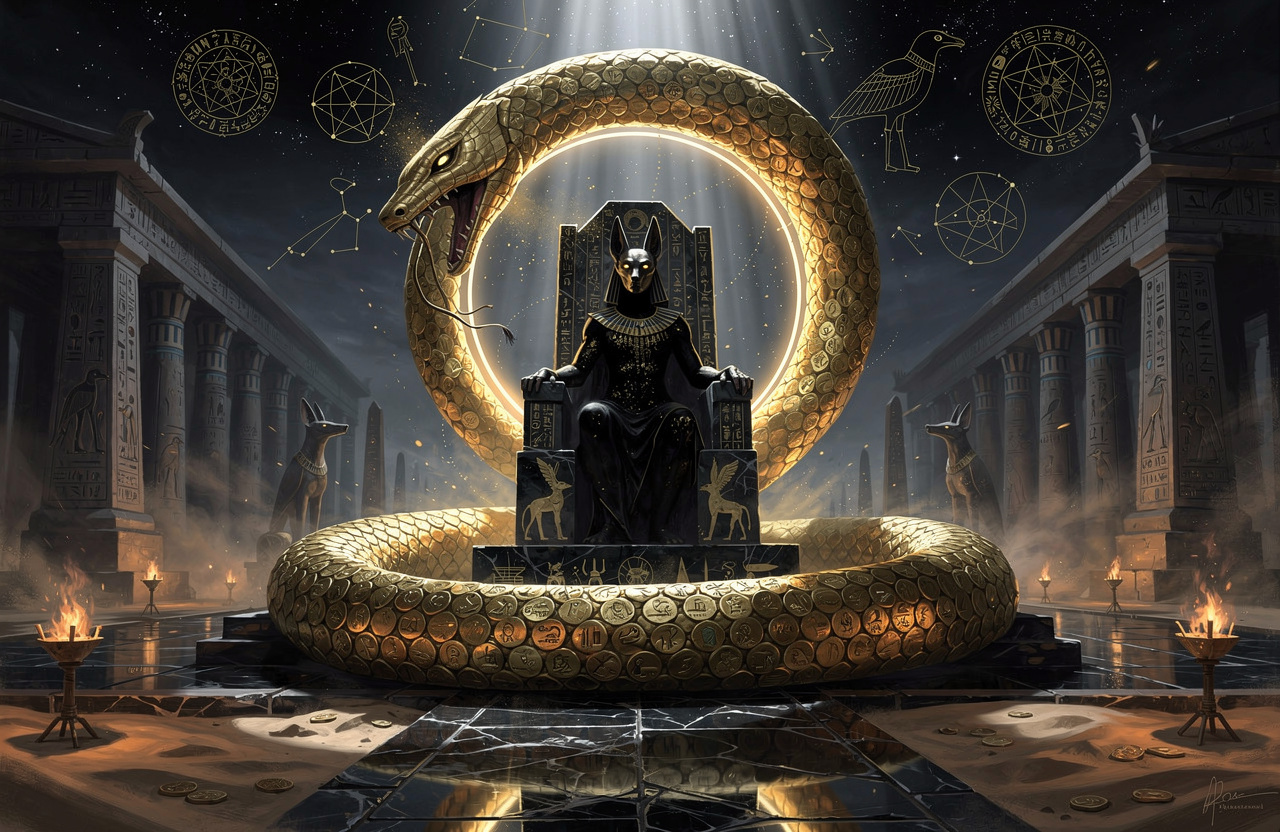
Of the Big Three, Vanguard is the strangest. BlackRock at least is legible: a public company, Larry Fink at the helm, a face and a set of filings. State Street is an old Boston bank. But Vanguard seems built on purpose so that when you ask "who owns it?" you shrug and move on. And that shrug is no accident. The shrug is the trick.
A fund with no owner
Vanguard was founded in 1975 by John Bogle — the man who invented the index fund and spent his life loudly scolding Wall Street elites. The idea was almost noble: a cheap fund for ordinary people, without greedy middlemen.
And he designed an unusual structure. Vanguard is owned by its own funds. The funds are owned by their shareholders — that is, the clients. Close the loop: you put money into a Vanguard fund, the fund co-owns the Vanguard management company, so formally you co-own the very entity that manages your money. Vanguard has no owning family, no outside shareholders to pay dividends to. It sounds almost like a cooperative.
Almost. Because this elegant scheme has one hole through which everything falls.
"You're an owner" — but without a single lever
Yes, formally you co-own Vanguard. Now try to use it. Appoint a director. Change the voting policy. Find out exactly how your Apple shares were voted at the last meeting. You can't. You have a slice of "ownership" and zero control.
It's like an open-source license whose README says "this project belongs to the community," while commit access sits with three people nobody elected and nobody can replace. Technically shared. Practically closed. Bogle designed a structure in which ownership is spread so thin it rounds to zero: everyone owns, the apparatus decides.
And the apparatus decides at scale. Vanguard has around nine trillion dollars under management. On the shares behind those trillions, Vanguard votes — not you, the "co-owner." Your formal ownership grants you not a single real vote in the companies where your money sits. The vote travels upward, to the manager. The same story as the pensioner's, only wrapped in the pretty label "the fund belongs to you."
Who owns the owner
Now the question of the day. If Vanguard has no owning family — who is at the top? And here you run into the ring.
Vanguard is the largest shareholder of BlackRock. BlackRock's funds hold State Street. State Street holds both. They own each other cross-wise, in a closed circle — studied academically (Fichtner, Heemskerk, Garcia-Bernardo, 2017). You ask "who is the beneficiary, who do we hold to account?" — and the arrow of responsibility runs around the ring and stops at no one.
The result is a perfect architecture of invisibility. Vanguard has no owning family — so there's supposedly no one to ask. Above sits a ring of mutual ownership — so accountability is tossed endlessly around the circle. And below, millions of "co-owners" without a single lever. There is power, there is concentration, but no one to blame. In IT we call it a circular dependency: impossible to untangle, because the ends are hidden inside the loop itself.
The "so no one's in charge" trap
Here most people jump to a conclusion: "if there's no family and no owner, then no one runs anything, it's all conspiracy nonsense." And that is precisely the reaction the design counts on.
Someone runs it. But in a way that leaves no ends to grab. The absence of a visible owner is not the absence of power; it is hidden power. An ancient principle: the nameless is all-powerful, the named is governable. As long as a structure has no name and no face, there is nothing to hold it to. Vanguard is the champion of this move: it is literally built to be "no one's," and that is exactly why it's so hard to call to account.
Where is the ordinary person here
You are that "co-owner" who was handed a certificate of ownership and never given the buttons. Your money works, your vote went upward, and to the question "who is responsible?" you get a circular arrow. You are inside a scheme that calls you the owner so that you won't look for the real one.
But notice: Bogle stumbled onto the right idea — a fund owned by its members. He just didn't finish it. He gave members no real vote and left control to a closed apparatus. Finishing it is our job.
What to do about it: the MAAT token and DAO
Vanguard shows what's missing: not "a certificate of ownership," but a real right to decide, plus transparency so you can see exactly how your vote was cast.
That is MAAT. The MAAT token is membership in a cooperative and a single vote. Not "one dollar, one vote" like the funds, but one human, one vote. And unlike Vanguard, the vote here does not vanish into a closed apparatus: governance runs through a DAO — a decentralized organization where the treasury is transparent and every movement of funds and every vote is visible in an open ledger. No ring in which accountability dissolves.
Half a century before us, Bogle guessed the direction — a fund should belong to its people. We simply carry the idea to its end: ownership without a real vote is an empty certificate, while ownership with a vote and a transparent treasury is already power. The entry is simple: read the book, take the token, get your vote — and finally become a co-owner who has a button.