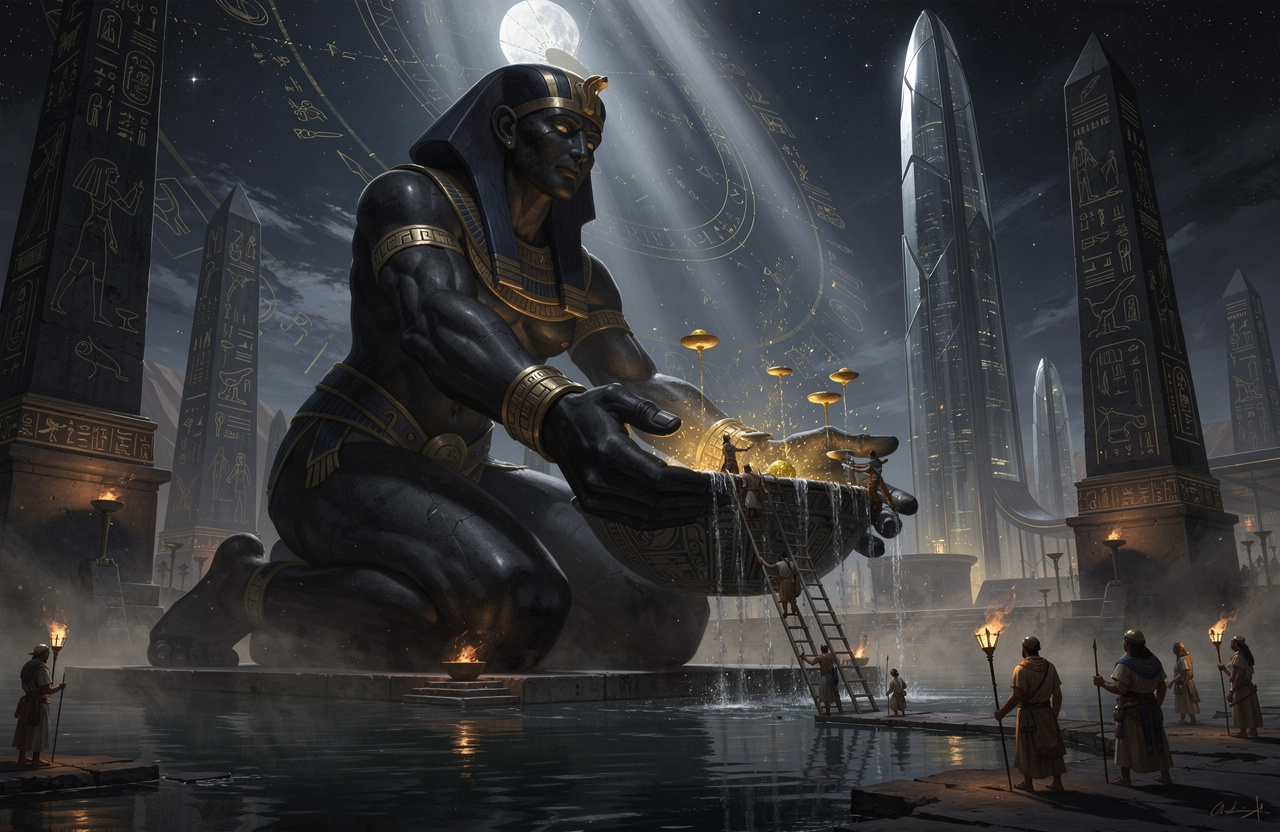
You can go a month without money. You can go weeks without a bank. You go about three days without water. It is the one input no human can opt out of — the most inelastic demand on Earth. Which is exactly why it is being turned, quietly and steadily, into an asset class.
Somewhere upstream of your tap there is now, increasingly, a shareholder. Not a mayor. Not a public works department answerable to a vote. A listed company whose job is to return capital to owners — and whose largest owners are the same index giants that own everything else. Vanguard. BlackRock. State Street. The water that keeps you alive flows, at the far end of the pipe, into a spreadsheet in Malvern, Pennsylvania.
From a public good to a line on a balance sheet
Two names to hold. Veolia — a French multinational, the largest water and environmental services company in the world, running water systems for tens of millions of people across dozens of countries. And American Water Works, ticker AWK, the biggest publicly traded water utility in the United States, serving millions of people across many states. Both are corporations. Both trade on public markets. And when you look at their major institutional shareholders, you find the same passive managers sitting at or near the top — Vanguard and BlackRock holding large stakes, as they do in nearly every large listed company.
So trace the line. A city, strapped for cash, signs a long-term deal handing its water system to a private operator, or sells its utility outright. The operator is a public company. The public company's shares sit in index funds. The index funds are run by a handful of managers. The end owner of the right to bill you for water is, functionally, the same concentrated pool that owns the food companies, the housing, the exchanges, and the debt.
The pitch for privatization is always efficiency: private operators invest, modernize, run it better than a sleepy municipality. Sometimes true. But the structural fact underneath the pitch doesn't change with the quality of service. A necessity with no substitute, priced by an entity whose duty is to its shareholders, is a machine for extracting rent from something you physically cannot refuse to buy. The incentive isn't villainy. It's fiduciary duty pointed at your throat.
The most inelastic demand on Earth
Understand why water is the prize. Markets discipline sellers through the buyer's ability to walk away. Don't like the price of a car, a phone, a vacation — you don't buy it. That "no" is the only real check on price. Water erases the "no." You will pay. Your children will pay. The demand curve is nearly vertical.
When a business owns something with vertical demand, it owns a near-perfect toll. Rate increases meet no exit. Underinvestment meets no competitor. The customer is captive by biology. This is why the smart, patient money loves regulated utilities: boring, monopoly, mandatory, forever. The very features that make water essential to you are the features that make it beautiful to the balance sheet.
And the concentration compounds. As the same few managers accumulate stakes across water, energy, food, and housing, they come to hold diversified positions in the entire apparatus of survival. Not a monopoly on any single utility — something subtler and larger. A broad, quiet ownership of the category of things people cannot live without. You don't need to corner one river when you own a slice of all of them.
Our Record
Here the Egyptian lens is not metaphor. It is almost literal.
Nun is the primordial water — the formless deep that existed before creation, out of which all life rose. In the old understanding, water is not a commodity. It is the substance of existence itself, the medium the gods shaped order from. To live is to be permitted to drink from Nun. Egypt itself was the gift of a river; the Nile's flood was Sekhem made visible, the life-force arriving on schedule to feed a whole civilization.
Now weigh what has happened. The formless deep, the common inheritance of every living thing, has been fenced, metered, and titled. The Shadow Neteru have laid claim not to gold, not to land, but to Nun — to the flowing source. To own the right to the water is to own the tap on the Sekhem of the living. When the source itself becomes a rent, the feather tilts against the whole arrangement, no matter how efficiently the pipes are run.
This is the Ring reaching its logical end: from money, to debt, to markets, to the exchanges, and finally to the water. Enclosure moves ever inward — from the luxuries, to the necessities, to the substance of life itself. Apep is thorough. It does not stop at your wealth. It reaches for the well.
The lever: what cannot be indexed
Never doom without a door, so here is the door — and it's stronger than it looks, because water is where the enclosure model is most exposed.
Water is intensely local. It cannot be shipped like oil or streamed like data. Every system is a specific place, specific pipes, a specific community that drinks from it. That locality is a weakness for the Ring and a strength for you. A global fund can own a slice of thousands of companies from a screen. It cannot love your river. It cannot show up to the town meeting. It has no stake in your children drinking, only in your children paying.
So the lever is ownership that stays where the water is. Municipal control kept in public hands, defended at the local level where the vote still bites. Water cooperatives and public trusts — structures that hold the source for use, not for yield, governed by the people who drink from it. These are old ideas, and they work: a commons managed by its commoners, accountable to thirst rather than to a quarterly return.
And the newer tools sharpen the old ones. Transparent governance, open ledgers, DAO-style cooperatives — these make it possible to own and manage shared infrastructure without a distant fiduciary skimming the flow. Collective ownership with rules anyone can read, votes anyone can verify, and no hidden shareholder upstream of the tap.
The Ring wants the water because you cannot say no to water. Say yes to it together, then — owned in common, governed in the open, priced for life instead of yield. What no one can refuse, no one should be able to enclose. Guard the well.