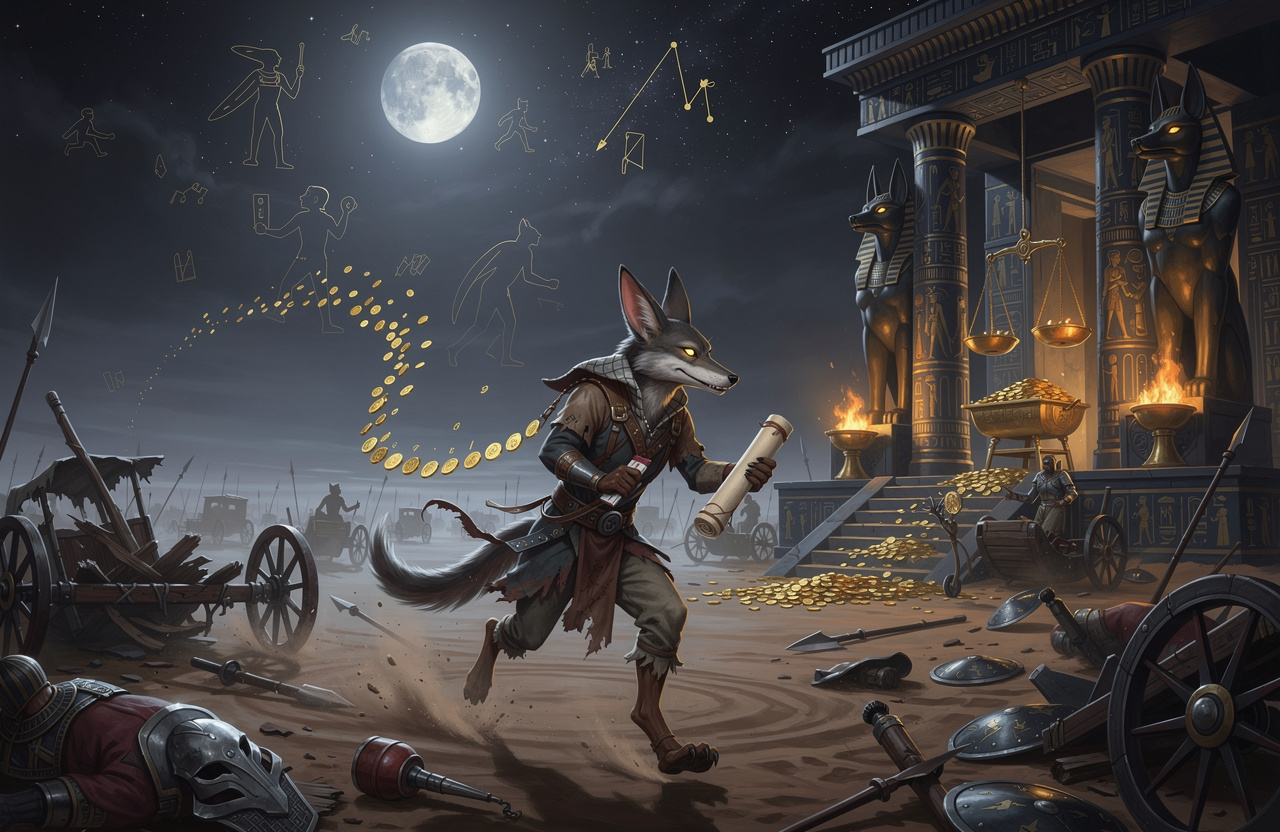
There is a dull truth in IT that whole fortunes rest on: whoever gets the data first wins. High-frequency traders spend millions to place their server a few meters closer to the exchange — for an edge measured in microseconds. It seems like a disease of the digital age. But the most famous example of "news equals money" happened on June 18, 1815, near a Belgian village called Waterloo. And so much legend has grown around it over two centuries that separating fact from myth has become a task in itself.
What actually happened
Fact one: the outcome of Waterloo was uncertain until the very end. Napoleon had returned from Elba, raised an army, and Europe held its breath. If he wins, British government bonds fall, because the war drags on and costs money. If the coalition wins, bonds soar, because peace and stability arrive.
Fact two: the House of Rothschild ran its own courier service — a web of riders, boats, and carrier pigeons that moved faster than the state mail. This was not magic but an investment in logistics. For years they had poured money into the speed of messages between their five nodes in London, Paris, Frankfurt, Vienna, and Naples.
Fact three: Nathan Rothschild in London very likely learned the outcome of the battle before the British government did — by several hours, possibly nearly a full day. Wellington's official dispatch traveled the ordinary route; the private Rothschild network was faster.
So far everything is verifiable and rather prosaic: good logistics produced an information advantage. After that, the folklore begins.
Where the myth starts
The legend tells a vivid scene. Nathan, knowing of the victory before anyone else, walks onto the exchange and ostentatiously begins to sell British bonds. The crowd reasons: if Rothschild is selling, Napoleon must have won, all is lost. Everyone rushes to sell, the price collapses. Then Nathan, through proxies, buys everything for a pittance — and a day later the official news of victory arrives, bonds soar, and he becomes fabulously rich in a single day.
A dramatic scene. The trouble is that its reliability is highly doubtful. Historians who have studied the archives point out that the scale of this "trade of the century" is greatly exaggerated, and that the "false sell-off" story was largely launched by a mid-19th-century pamphlet with an openly antisemitic flavor. In other words, the specific dramatic scene is most likely a myth attached to a real advantage.
Let's draw the line honestly. Fact: the Rothschilds had an information and logistics edge, and they genuinely knew how to profit from it. Myth: that a fortune's foundation was struck at Waterloo through one trick that fooled the crowd. Reality is duller: their strength lay not in a single brilliant day but in dull infrastructure of speed, built over years.
Why this matters more than the pretty legend
And here is the real lesson the legend actually obscures. Everyone argues whether Nathan tricked the crowd or not. What is genuinely interesting is something else: why did a private family's courier network end up faster than an entire state's?
Because the state treated information as a bureaucratic procedure, while the Rothschilds treated it as an asset. They understood before others that information is not a description of money — information is money. Whoever sees reality an hour earlier lives in slightly different time than everyone else and trades with them as an adult trades with children.
In that sense Waterloo is not a story about deception but about asymmetry. One side knows, the other doesn't. And that crack in time gets monetized. Today it is exactly the same: insiders, fund research desks, paid access to data a fraction of a second ahead of the market. The architecture hasn't changed — only the horseback couriers have been replaced by fiber optics.
Where is the ordinary person in this
In the usual place — the one who finds out last. By the time news reaches you in the morning headlines, it has already been played out by those who got it hours or days earlier. You buy at the highs and sell in the panics, because you react to a signal that, for the big players, went stale long ago.
This is not because you are dumber. It is because you stand at the very end of the information chain — where the data arrives pre-digested. You have no courier network of your own. They do.
The answer: the MAAT token and DAO
There is only one cure for information asymmetry: transparency by default. If you can't give everyone an insider's speed, you can build a system where there is no privileged access at all — where the rules, the treasury, and the decisions are visible to everyone at the same moment, not to "insiders" first and the rest later.
That is the logic of MAAT. The MAAT token is membership in a cooperative and a vote under the principle of one human, one vote, not "one dollar, one vote." Governance runs through a DAO with a transparent treasury: every movement of funds is written to an open ledger, and there is no "room" where the news arrives a day early. The Rothschilds profited because some saw reality before others. We are building the opposite — a space where everyone sees the same thing at the same moment. The entry is simple: read the book, take the token, get your vote — and stop being the one who finds out last.