DAOs were supposed to kill the boardroom. No CEO, no board, no closed-door deals — just the community, voting on-chain, in the open. Power to the people.
Then reality shipped a bug. In most DAOs, "the people" means "the tokens." One token, one vote. And whoever holds the most tokens decides. That's not democracy. That's a shareholder meeting with better graphics.
Look at what actually happens on-chain and you'll see it: a handful of wallets, a few funds, an early investor or two, quietly holding enough tokens to swing any proposal they care about. The community votes. The whale wins. Every time.
One token, one vote is just plutocracy with extra steps
Here's the mechanism, stripped bare. In a token-weighted vote, your influence equals your holdings. Ten thousand tokens, ten thousand votes. Ten small holders with one token each? They can be outvoted by one person who bought eleven.
That's not a flaw in the implementation. That is the design. "One token, one vote" is rule by capital, stated honestly. It does exactly what it says: it hands the loudest voice to the deepest pocket. We already have a system that works like that. It's called a corporation. The whole promise of a DAO was to be different.
And the concentration is worse than in a public company. Public firms have disclosure rules, blockholder reporting, regulators. A DAO has a token distribution set at launch — and if the founders, the seed round, and a couple of funds got the bulk of supply, the "decentralized" org is a plutocracy from block zero. The DAO looks like a town hall. The cap table says it's a monarchy.
How a whale buys a decision
Watch the play in practice.
A proposal comes up — say, redirecting the treasury toward something that benefits one investor. In a healthy community, it'd be debated and probably rejected. But a whale doesn't need to win the debate. They need to win the count.
- Direct weight. They already hold enough tokens to pass or block it alone. The vote is theater; the result was decided at token-distribution time.
- Buy the margin. Short of a majority? On a liquid market, they buy more tokens right before the vote, cast them, and sell after. Rent the votes, return them at closing. Legal. Devastating.
- Bribe the quorum. "Vote-buying" markets exist where holders are literally paid to delegate their votes a certain way. A whale doesn't even need the tokens — just enough cash to rent other people's.
- Exploit apathy. Most token holders never vote. Turnout in DAO governance is often a small fraction of supply. When 90% don't show up, you don't need a majority of tokens — just a majority of the tiny slice that bothers. The whale always bothers.
Add these together and the picture is grim: the richer you are, the more the outcome is simply yours. The vote isn't a check on power. It's a laundering machine that dresses one wallet's will in the costume of consensus.
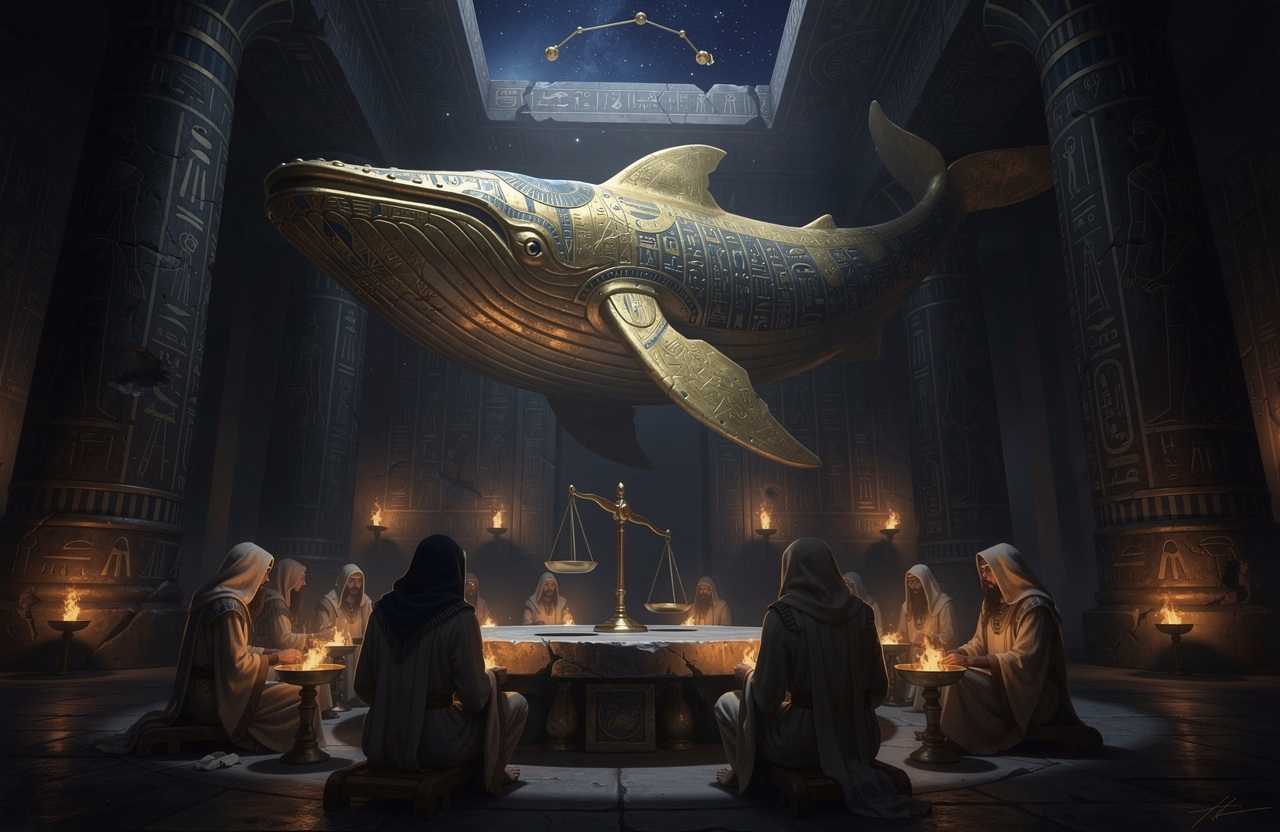
Our record. Isfet is not chaos flailing at random. Isfet is parasitism wearing the mask of order — the few draining the many while the ritual of fairness plays on. The token-weighted vote is Isfet's favorite disguise: it keeps the form of participation and hollows out the substance. Everyone votes; one wallet decides. The Scales of Maat weigh a deed against a feather — a single true measure. But a rigged scale that adds a thumb for every coin is not the Scales of Maat. It is Isfet forging the instrument of judgment and calling it justice. Name it plainly, and half its power dies: this is not governance. This is capital cosplaying as a commons.
Why MAAT does it differently
We say this out loud because we refuse to build the thing we're warning you about.
Pure token-weighted voting reproduces the exact power structure that DAOs claimed to escape. If the whale always wins, the "decentralized" org is a legacy hierarchy with a blockchain skin. So we design against it. The honest order of our thinking:
- Weight the human, not just the wallet. Governance must include a measure that scales with people, not only with capital. Mechanisms like quadratic voting bend influence away from raw balance and toward breadth of support — many voices count more than one deep pocket. (More on the exact mechanics in the companion pieces on quadratic voting and sybil resistance — because those tools have their own hard tradeoffs, and we won't pretend otherwise.)
- Proof of personhood underneath. Weighting by human only works if you can't fake being a thousand humans. Sybil resistance is load-bearing. No honest one-person-one-vote survives without it.
- Transparency as default. Every vote, every delegation, every treasury move on the open ledger. The Scales stay visible. Whales can't hide, and neither can we.
- Say the tradeoffs out loud. There is no perfect voting system — that's a mathematical fact, not an excuse. Every mechanism can be gamed by someone. Our job isn't to claim we solved governance. It's to make capture expensive and visible instead of cheap and silent.
The lever
Here's the thing worth holding onto. The whale's power in a DAO isn't magic — it's a design choice. Someone chose "one token, one vote." Someone can choose otherwise. Governance is code, and code can be forked.
So the question for any DAO you touch is simple, and you can check it yourself before you trust it with a dollar:
- Who holds the tokens? Pull the distribution. If a few wallets hold the majority, the vote is decoration.
- Does the mechanism weight people or only capital? If it's pure token-weight, assume the richest holder governs.
- Can one entity fake being many? If there's no sybil resistance, "one person one vote" is a slogan, not a fact.
A vote you can't lose isn't democracy — it's a receipt. Read the cap table before you read the manifesto. The manifesto is Hekau, the creating word; the cap table is what the word actually built. When they disagree, believe the ledger.
Power hidden inside a quorum is still power. Name the whale, and the water gets a lot clearer.