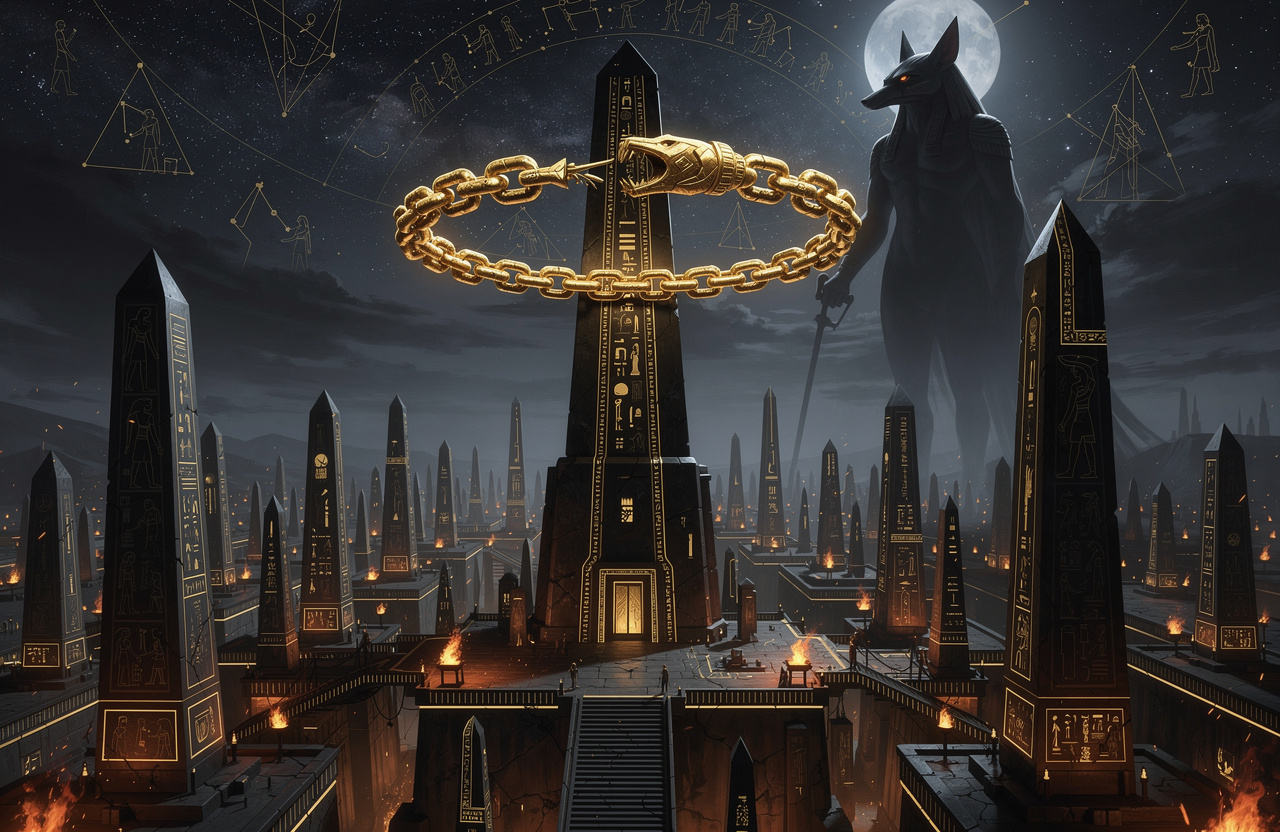
Ask a simple question — who owns BlackRock? — and the answer eats its own tail.
BlackRock is the largest asset manager on Earth, steering something on the order of ten trillion dollars. It has a hand in nearly every large company you can name. If capitalism had a control tower, this would be a strong candidate for the room. So the ownership question is not idle. Whoever owns the owner of everything owns everything. You'd expect a name. A family. A face at the top.
Follow the chain up, and you do not find a face. You find a loop.
Pull the Thread
BlackRock is a public company. So we can look at its largest shareholders — the entities holding the biggest stakes. Do that, and the top of the list is telling.
Among BlackRock's very largest shareholders sits Vanguard. Vanguard — the second colossus of asset management, itself steering trillions — is one of the biggest owners of BlackRock. And who is among the largest owners of Vanguard's rivals, and of the funds that hold BlackRock? BlackRock. The two giants hold each other, and hold nearly everyone else, and are held in turn by the same diffuse cloud of index funds they themselves operate.
Try to draw the ownership diagram and your pen never lifts. BlackRock is a top holder in thousands of public companies. It is also a top holder — through its own funds and through Vanguard — in the companies that hold it. The arrows leave BlackRock, travel across the market, and arc back into BlackRock. There is no apex. There is a circle.
This is the thing people miss when they look for "the man at the top." There is no top. The structure is not a pyramid with a pharaoh at the point. It is a ring — a closed loop of mutual ownership where the biggest owners are, in large part, each other.
The Serpent That Eats Its Tail
The old Egyptians drew a creature for exactly this shape. Not the benevolent ouroboros of later myth — something older and colder. Apophis — Apep — the great serpent of the primordial dark, the coil that encircles and swallows, entropy given a body. Every night Apophis waited to devour the sun-boat and unmake order. The gods did not defeat him once. They fought him every night, forever, because he was not an enemy you kill — he was a pattern that reforms.
A ring of ownership that loops back on itself is Apophis in a spreadsheet. It has no head to cut off. Point at any one company — BlackRock, Vanguard, the index funds, the giant pensions — and it will honestly tell you it is owned by others. And it is. It's owned by the next arc of the ring, which is owned by the next, which loops back to the first. Everyone is a servant. No one is the master. The coil owns itself.
That is not a bug in the machine. Look closely and you'll see it's the most defended feature. A pyramid has an apex you can name, tax, subpoena, overthrow. A ring has no apex. You cannot behead a circle. Ask "who is responsible?" and the ring answers, in perfect legal honesty, no one in particular — while the concentration of power it produces is as real as gravity.
Our Record
Our record: the Ring is Apophis given corporate form — Isfet not as loud chaos but as a closed coil that has swallowed its own beginning. In the order of Ma'at, every action has an author who stands before the scale and answers for the weight of his heart. The Ring's genius is to erase the author. It diffuses agency around a loop until no single Ba can be summoned to the weighing — every node points to the next, and the feather has nothing to balance against. Power without a face is Isfet's masterwork, because a face can be judged and a loop cannot. The serpent that eats its tail has committed the one perfect crime: it left no one to accuse.
But the Loop Still Has a Voice
Here is where the abstraction turns concrete and cold.
A ring with no owner still acts. BlackRock votes the shares it holds — in thousands of companies, on the boards, on the pay, on the direction. Vanguard does the same. Through this, a tiny handful of firms cast an outsized share of the votes across the entire public market — steering companies that compete with each other, all nudged by the same few hands. The ownership loops back on itself and finds no master, but the influence points outward, sharp and real, onto the actual economy you live inside.
And notice the tool underneath. BlackRock runs a risk-and-analytics engine — Aladdin — that watches over an enormous slice of the world's investable assets, far beyond BlackRock's own. Much of the market's money is managed while looking through the same lens, reading the same risk signals, likely to lean the same way at the same moment. The ring does not just own quietly. It sees through one eye and can move as one body. A faceless owner with a single nervous system is not weaker than a tyrant. It is harder to fight, precisely because there is no throat to grip.
The Lever
Do not read the ring as invincible. Read it correctly, and you find the weakness hidden inside its strength.
The gods never killed Apophis — but they never lost, either. The trick was that they did not look for a head to sever. They understood the serpent as a pattern, and they met it with a counter-pattern, renewed every single night. That is the instruction.
You will not untangle the ownership loop by finding its owner — there isn't one. You defeat a closed coil by building an open one beside it. Structures where ownership is legible, where the voter and the owner are the same person, where you hold the keys and cast your own vote — not a proxy cast by a giant "on your behalf." Cooperatives. Transparent on-chain ownership where the ledger is public and the loop cannot hide. DAOs where governance is a right you exercise, not a share someone votes for you.
The ring's power is opacity and diffusion. The counter-spell is transparency and self-custody. Every asset you hold directly, every vote you cast yourself, every share of your economic life that runs on an open ledger instead of inside the coil — that is one arc pulled out of Apophis and rewoven into Ma'at.
The serpent has no head. Fine. Then stop hunting for one. Build the open ring, hold your own thread, and let the closed coil devour only itself.