You think of a stock exchange as a place. A building on Wall Street with a bell. A referee — neutral, above the game, keeping the market fair. It rings the opening bell for other people's companies. It is the stage, not an actor.
That picture is a century out of date. The exchange is not a referee. It is a for-profit corporation. It has shareholders. It reports earnings. Its stock trades — on itself. And when you ask who owns it, you find the same names sitting at the top of every other listing on the board.
The New York Stock Exchange is owned by Intercontinental Exchange, ticker ICE, a publicly traded company worth well over a hundred billion dollars. Nasdaq is a publicly traded company too, ticker NDAQ. Both list their own shares on markets they operate. The stage sells tickets to itself and takes a cut of every trade that crosses it.
The referee is a listed company owned by the players
Follow the ownership up and the loop closes on itself. Who are the largest shareholders of ICE and Nasdaq? The big passive managers — Vanguard, BlackRock, State Street — the same index behemoths that top the shareholder list of nearly every large public company in America. The firms that own the most stock also own large stakes in the venues where that stock is traded.
Sit with that. The referee is a company. The company is owned by the biggest players in the game. The players own a piece of the field, the scoreboard, and the guy blowing the whistle. It's not a conspiracy — it's just the structure of passive ownership applied consistently. When three managers own a percent or several of everything, they own a percent or several of the exchange too, by definition.
And the exchange makes money three ways, all of them off your activity. Transaction fees on trades. Listing fees from companies. And — the quiet giant — market data. Exchanges sell the price feed. The very information about what things cost is a product, and it's one of the most profitable lines they have. You generate the data by trading. They package it and sell it back. To you.
Trading is a toll road, and everyone pays the same family
Here is the shape once you see it. Every transaction in the public markets crosses infrastructure owned, ultimately, by the same handful of concentrated managers. You buy an index fund. The fund holds shares of companies. Those shares trade on an exchange. The exchange is a listed company. Its top owners are the index funds. The snake has its tail in its mouth.
ICE didn't stop at owning NYSE, either. It bought its way across the plumbing — clearing, data, mortgage technology, fixed-income pricing. It owns pieces of the machinery that decides what a bond is worth and what a home loan costs to process. The "exchange" grew into a toll network laid across the financial system, collecting at every gate. And the gatekeeper's stock sits in the same funds as everything the gate lets through.
This is what people miss when they picture markets as an open field of buyers and sellers. There is no open field. There is a privately owned network, monetized at every hop, whose owners are the same entities that own the assets moving across it. Rails, cargo, and railroad company — one cap table.
Our Record
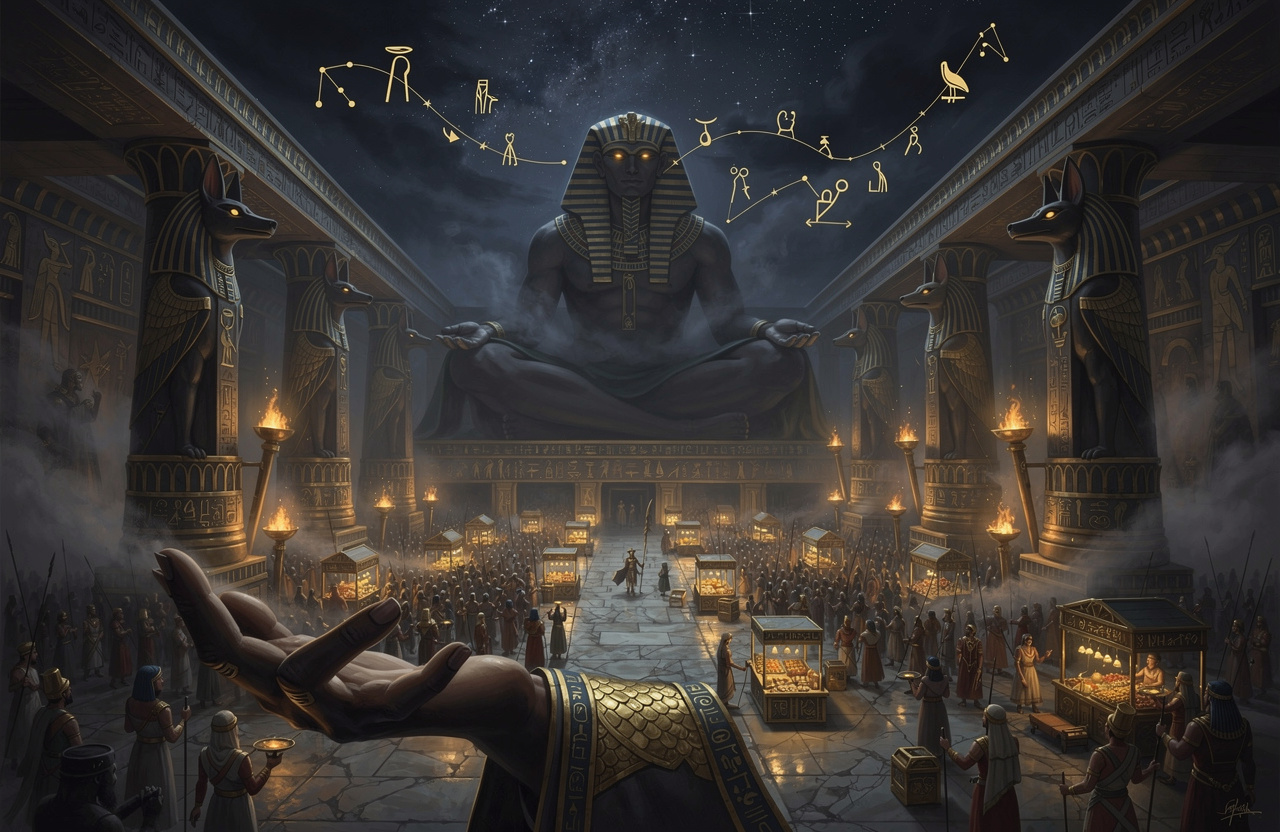
In the ledger of Maat, weigh this: who holds the scales?
The exchange was meant to be the Scales themselves — the neutral place where value is weighed honestly, where the heart of a company meets the feather of the market's judgment. A commons. A public square with a floor everyone could stand on.
But the Scales have been bought. The instrument of weighing is now owned by the heaviest hearts on it. When the Shadow Neteru own the balance, every measurement tilts by construction — not through fraud, but through the simple fact that the measurer profits from the measuring and answers to the measured.
Nun — the primordial waters, the formless deep from which order rises — was meant to flow through a channel no one owned, so that price could surface freely. Instead the channel itself was enclosed, metered, and sold. The water still flows. But every drop now passes a turnstile, and the turnstile belongs to the Ring.
The lever: markets you don't have to rent
Don't read this as despair. Read it as a map of where the toll booths are — because once you can see the toll booths, you can look for roads that don't have them.
Here's the crack. An exchange is, at bottom, just a matching engine and a ledger. Match buyers to sellers, record who owns what. For two hundred years that required a trusted private company sitting in the middle, taking a cut, selling the data. It doesn't anymore. That's the whole quiet revolution underneath the noise.
A decentralized exchange is a matching engine and a ledger written as open code, running on infrastructure no single company owns. The order book is public. The rules are auditable. Nobody sells you back the price data — the price data is the chain, and the chain is open. The referee becomes a protocol, and a protocol can't own shares in itself or answer to the players.
That's not utopia. Early DEXes are clumsy, and they have their own risks — read the code, hold your keys, trust nothing you can't verify. But the principle is sound and already running in the wild: the matching function can be a commons again. The Scales can be un-bought.
The old exchange rings a bell it owns, on a stage it owns, for players who own it. The new one has no bell and no owner — just a ledger anyone can read. Learn who holds the scales today. Then help build the ones no one can hold.