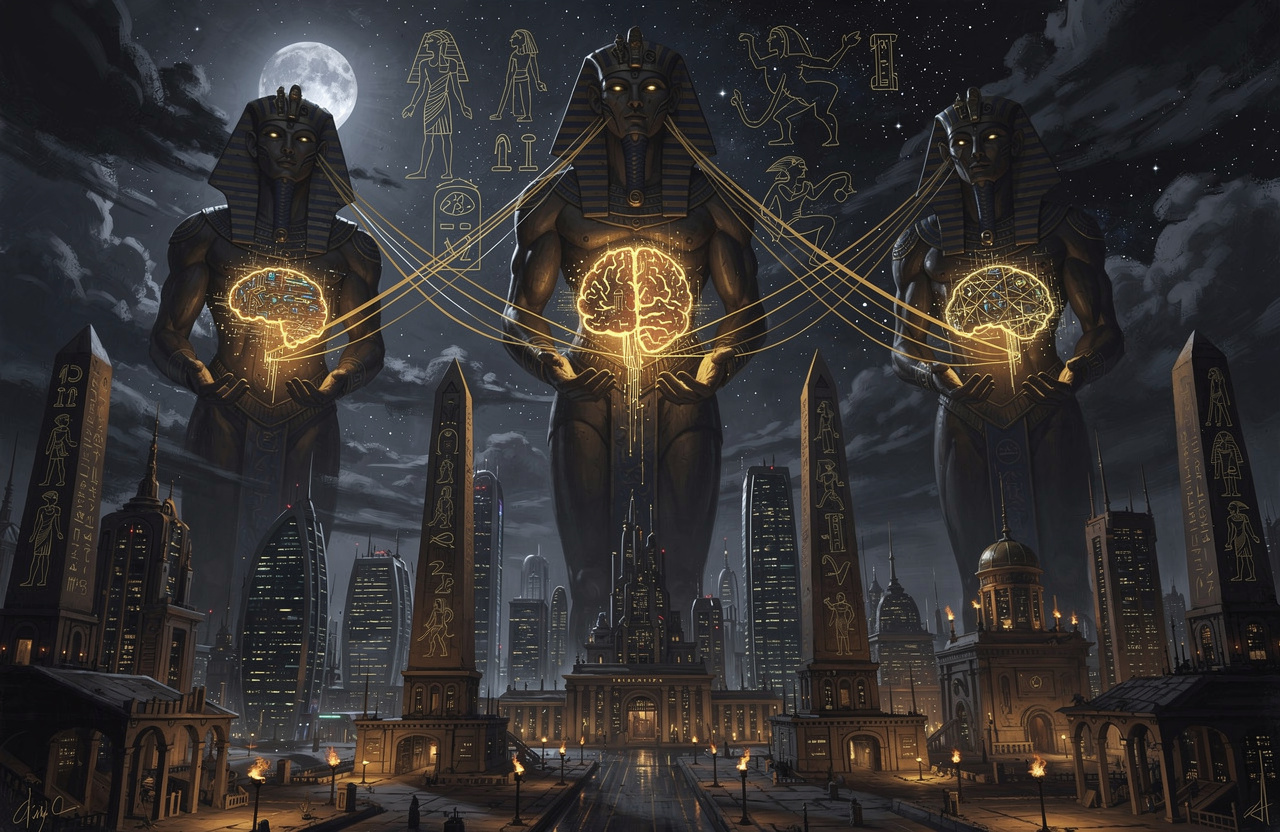
There are more languages spoken on Earth than there are companies that can build a frontier mind. Roughly seven thousand tongues. Roughly four labs.
Count them yourself. OpenAI. Anthropic. Google DeepMind. And behind or beside them, the cloud giants who pay the bills — Microsoft, Amazon, and Google again, wearing a second hat. That is the whole front line of machine cognition. Not a hundred players. Not a thousand. A handful you could name on one hand and still have fingers left for your coffee.
Lift your head from the headlines about "the AI race." There is no race between millions. There is a small room, and everyone in it already knows everyone else.
The Priesthood Is Small on Purpose
A frontier model is not written the way software used to be written — one clever person in a garage. It is summoned. It costs hundreds of millions of dollars in compute to train a single top-tier model. It requires tens of thousands of the most advanced chips on the planet, a talent pool of maybe a few thousand researchers worldwide, and datasets scraped from the entire recorded output of the human species.
Those are the barriers. And barriers, always, decide who gets to be a priest.
In the old temples, only initiates could enter the inner sanctum and speak the words that moved the god. Not because the words were secret magic — because access was rationed. The priesthood stayed small so the power stayed concentrated. Read the AI landscape and you are reading a temple map. The inner sanctum costs a billion dollars to enter. That is the whole trick. It was never about intelligence being rare. It is about the cost of the altar being high.
Follow the Money, Find the Owner
Here is where the map gets honest.
Anthropic looks independent. It is a company with its own name, its own model, its own mission. Then you follow the capital. Amazon has poured billions into Anthropic — on the order of eight billion dollars committed — and Google put in billions of its own. Anthropic's models run largely on Amazon's cloud and on Google's infrastructure. So who owns the machine mind called Claude? Anthropic builds it. But two of the largest corporations on Earth hold the wiring, the money, and a strategic seat.
OpenAI looks independent too. Then you follow the capital. Microsoft has invested on the order of thirteen billion dollars and, for years, was the exclusive cloud on which OpenAI's models breathed. The lab makes the mind. The giant owns the lungs.
See the pattern? The famous labs are the faces. The cloud giants are the bodies. Anthropic, OpenAI, DeepMind — these are the names on the temple door. Amazon, Microsoft, Google — these are the ones who own the temple, the land under it, and the road that leads to it. When you cannot afford to run your own mind, you rent one. And the landlord is always one of three.
Our Record
Our record: the Shadow Neteru learned a lesson from the old kings — you do not need to hold the crown if you hold the granary. Let the labs wear the crowns. Let them give speeches about safety and superintelligence and the future of humanity. The Shadow Neteru does not care about the crown. It owns the compute, the capital, and the cloud. It owns the body the mind must inhabit. Ba without a body is a ghost. And every frontier Ba on Earth is renting its body from three landlords. That is not a marketplace of ideas. That is a manor with three owners and a very long list of tenants.
Why "Which Lab Wins" Is the Wrong Question
Everyone argues about the leaderboard. Which model is smartest this month. Which lab shipped the better benchmark. Wrong altitude — again.
The labs compete on the surface and converge underneath. They fight for headlines and share the same three clouds, the same chip supplier, the same tiny talent pool that rotates between them. A researcher leaves DeepMind, joins Anthropic, gets poached by OpenAI. The knowledge circulates inside the room and never leaves it. This is not a competitive market. It is an oligopoly of consciousness that stages a rivalry for the cameras while pooling the actual means of production.
And an oligopoly of consciousness is a new kind of thing. Not an oligopoly of oil, or steel, or search. An oligopoly over the substrate of thought itself — over the systems that will increasingly write, decide, filter, summarize, and mediate what a civilization knows. When four companies own the machines that will help draft the laws, price the loans, moderate the speech, and answer the child's homework question, you are not looking at an industry. You are looking at a cathedral being built over the human mind, and only four sets of keys.
The Lever
Do not read this as doom. Read it as a map — and a map is a gift, because it shows you exactly where the walls are.
The concentration is real, but it is brittle, the way all concentration is brittle. Four keys is a lot fewer than a million keys, but four keys is also four single points of failure. And the counter-force is already loose in the world.
Open-weight models — released by labs and communities, some rivaling the closed giants — can be downloaded, run, and owned by anyone with the hardware. You are not required to rent your mind by the token. Small models now run on a laptop. Nations are funding sovereign labs so they never have to beg one of three landlords for permission to think. Every open release is a copy of the sacred words leaving the temple and reaching a person who was never supposed to hold them.
Your move is not to pick a favorite lab. Your move is to refuse the frame that a mind must be rented. Run an open model locally. Support the projects that give the weights away. Learn to summon on hardware you actually control. When the priesthood insists the altar costs a billion dollars, remember that the words themselves are free — the price was always the gate, never the god.
Name the four landlords. Draw the map. Then start building doors they do not own.
The mind of the age has owners today. It does not have to have owners tomorrow. That part is still being written — and you have a key.