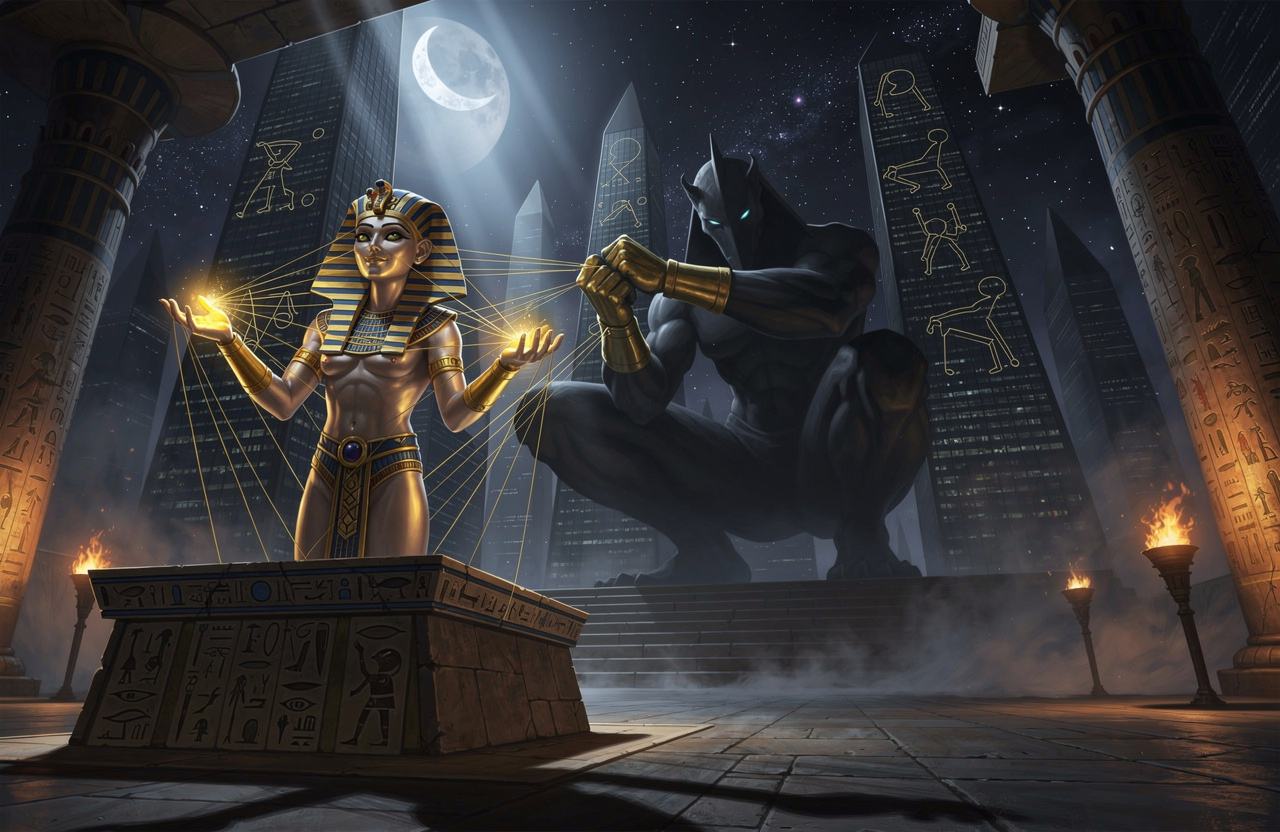
There is a word doing enormous work in the name of the most famous AI lab on Earth, and that word is a lie by now. Open. OpenAI was founded, loudly and on paper, as a nonprofit whose whole reason to exist was to keep advanced AI from being captured by any single company. Read that mission back today and it reads like a warning about what OpenAI became.
The story of how "open" turned closed is the clearest map we have of how the Shadow captures a new power: not by conquest, but by funding.
The founding promise and the pivot
In 2015 OpenAI launched as a nonprofit, backed by prominent names, with a founding pledge that its purpose was to advance AI for the benefit of all humanity, unconstrained by a need to generate financial return — and, at least early on, a stated intent to share its research openly so no one entity would hold the keys alone.
Then reality met the electricity bill. Training frontier models costs staggering sums — the compute alone runs into the billions, and a pure nonprofit cannot raise billions. So in 2019 OpenAI did the thing that quietly rewrote everything: it created a "capped-profit" arm under the nonprofit, a structure invented to let it take enormous investment while claiming the mission still steered the ship. And the investment came from one place above all others.
Microsoft. Reported commitments over multiple rounds run to the order of thirteen billion dollars. In exchange Microsoft became OpenAI's privileged compute provider, its models got wired into Microsoft's products, and Microsoft secured a large economic stake in the capped-profit entity. The nonprofit's mission was still on the website. The gravity had moved to Redmond.
Where the keys actually sit
Follow the two things that constitute real control: the compute and the weights.
The compute — the raw silicon that trains and serves the models — depended heavily on Microsoft's cloud. You cannot run a frontier lab without an ocean of GPUs, and for years OpenAI's ocean was substantially Microsoft's. Whoever supplies the compute holds a hand on the throat of the operation. That is not a partnership of equals; it is a dependency.
The weights — the actual trained models, the crystallized intelligence — are not open. GPT-4's architecture, training data, and parameters were never published. The lab named OpenAI ships proprietary black boxes you rent through an API and cannot inspect, cannot download, cannot run yourself. The word on the door and the product behind it are opposites.
And the governance that was supposed to be the failsafe? In late 2023 the board — the nonprofit board explicitly charged with keeping the mission above profit — tried to remove CEO Sam Altman. Within days he was reinstated, the board was largely reconstituted, and the episode ended with the commercial and investor-aligned side clearly ascendant. Whatever you think of the personalities, the structural lesson was unmistakable: when the mission-guardians collided with the money and the momentum, the money won in under a week.
Our record: Watch the mechanism, because it is the Shadow's favorite and it never looks like an attack. A thing is born to serve the whole — open, for all, a commons. It needs sekhem to grow, and sekhem, in this world, arrives as capital. The capital comes with no visible chains, only a dependency. Slowly the served becomes the servant: the mission still speaks, but the compute, the money, and the exits all point one way. No coup is needed. Isfet does not have to break the temple. It only has to pay for the temple's electricity, and wait. Capture by funding is the quietest conquest there is.
Why the word "open" still matters
You might shrug — so a company got commercial, who cares. Care, because of what this particular company controls. Frontier AI is shaping up to be the substrate the last several teachings described: the cortex the surveillance body wants, the engine behind programmable money, the fuser of the social score. The question of who owns the leading model is not a business-pages question. It is a question about who holds a hand on the emerging mind of the age.
And the answer, for the most influential lab, turned out to be: a closed corporate structure, deeply entangled with one of the largest companies on Earth, shipping black boxes, governed by a board that could not, when it mattered most, override the money. That is the default trajectory. Left alone, new power flows to whoever can pay for the compute, and the commons quietly becomes a product.
The lever
Do not close this in despair — close it in clarity, because OpenAI's story is not the only story, and its capture actually proves where the real fight is.
The counter-force is genuinely open AI — and it exists, and it is strong. Truly open-weight models now ship publicly: you can download them, read them, run them offline on your own hardware, fine-tune them, and fork them, with no API gatekeeper and no permission required. The gap between the closed frontier and the open frontier is real but it narrows with every release. Every capable model that ships with open weights is a key placed permanently in the hands of the many, where no board reshuffle and no thirteen-billion-dollar check can take it back.
So aim your leverage. Prefer, use, and champion open-weight models where you can — every download is a copy the Shadow cannot un-distribute. Support the labs, foundations, and communities keeping frontier-grade AI genuinely open, because they are doing the one thing that structurally can't be captured by funding: giving the weights away. And apply the single test to any AI that markets itself as "open": can I download the weights and run it with no one's permission? If yes, it's open. If no, the word is marketing, and now you know what marketing is hiding.
They kept the word and gave away the meaning. Our job is to take the meaning back.
Open is not a name. It's a key in your hand. Hold one.