Roughly 80 percent of everything you own crossed an ocean on a ship. The phone in your hand, the shoes on your feet, the coffee in your cup, the chips inside every device you love — almost none of it was made where you live. It came in a steel box, stacked forty high on a vessel longer than four football fields, and it touched land at exactly one kind of place: a container terminal. There are only so many of those on Earth. And there are only so many companies that own them.
That is the whole game. You do not need to own the ocean. You do not need to own the factory. You need to own the narrow slot the goods must pass through — the pinch point where the world's supply chain squeezes down to a single quay, a single crane, a single toll. Own the neck of the bottle, and everything downstream pays you to breathe.
The chokepoint is the asset
Forget the romance of ships. The value is not the water; the value is the gate. A few dozen terminals handle a wildly outsized share of global container traffic, and a small cluster of operators run them. DP World, out of Dubai, operates terminals across roughly six continents. Singapore's PSA is one of the largest terminal operators on the planet. Hutchison Ports, tied to Hong Kong's CK Hutchison, runs terminals in port after port across dozens of countries. Maersk — the Danish shipping giant — doesn't just sail boats; through its terminal arm it owns the docks too, vertically integrating the ship and the pier.
Now layer in the money above the operators. In early 2025, a BlackRock-led consortium struck a deal worth on the order of tens of billions of dollars to acquire a large basket of ports — including terminals at both ends of the Panama Canal — from CK Hutchison. Read that again slowly. The largest asset manager on Earth, the firm that already sits atop the S&P 500 through its index funds, reaching to buy the physical gates through which a huge share of world trade must pass. Not stocks about trade. The trade itself — the concrete, the cranes, the choke.
The Panama Canal is the perfect illustration. It is a ditch, roughly fifty miles long, that saves a ship from sailing all the way around South America. A large slice of certain trade routes has no realistic alternative. Whoever controls the terminals at its mouths does not need a monopoly on shipping. They own the doorway, and the doorway charges rent to every box that walks through.
Rent on the neck of the world
Here is why logistics is such a beautiful asset to the patient, concentrated money — and why it is such a quiet danger.
A toll on a chokepoint is invisible. When the price of a terminal fee, a canal transit, or a demurrage charge ticks up, it does not show on your receipt as "port rent." It dissolves into the price of the shoe, the phone, the coffee. You pay it a thousand times a year without ever seeing the line item. That invisibility is the feature. A visible tax gets voted down. A tariff buried in the cost of a container gets paid forever, by everyone, without a murmur.
And the demand is nearly inelastic. An economy cannot opt out of imports. A nation that stops receiving containers stops eating, stops manufacturing, stops functioning within weeks. So the goods must move, which means they must pass the gate, which means the gate can price to the edge of what the flow will bear. That is the same vertical demand curve that makes water and index funds and debt such prizes: the buyer cannot walk away. The customer is captive by geography.
Concentration compounds it. When the same handful of operators and the same handful of asset managers own terminals across every continent, they are not competing for your cargo — they are dividing the map. A single blockage, a single fee schedule, a single decision in a boardroom in Dubai or New York or Copenhagen ripples through the price of everything, everywhere. The supply chain the whole world calls "global" narrows, at the physical layer, to a few dozen gates held by a few dozen hands.
Our Record
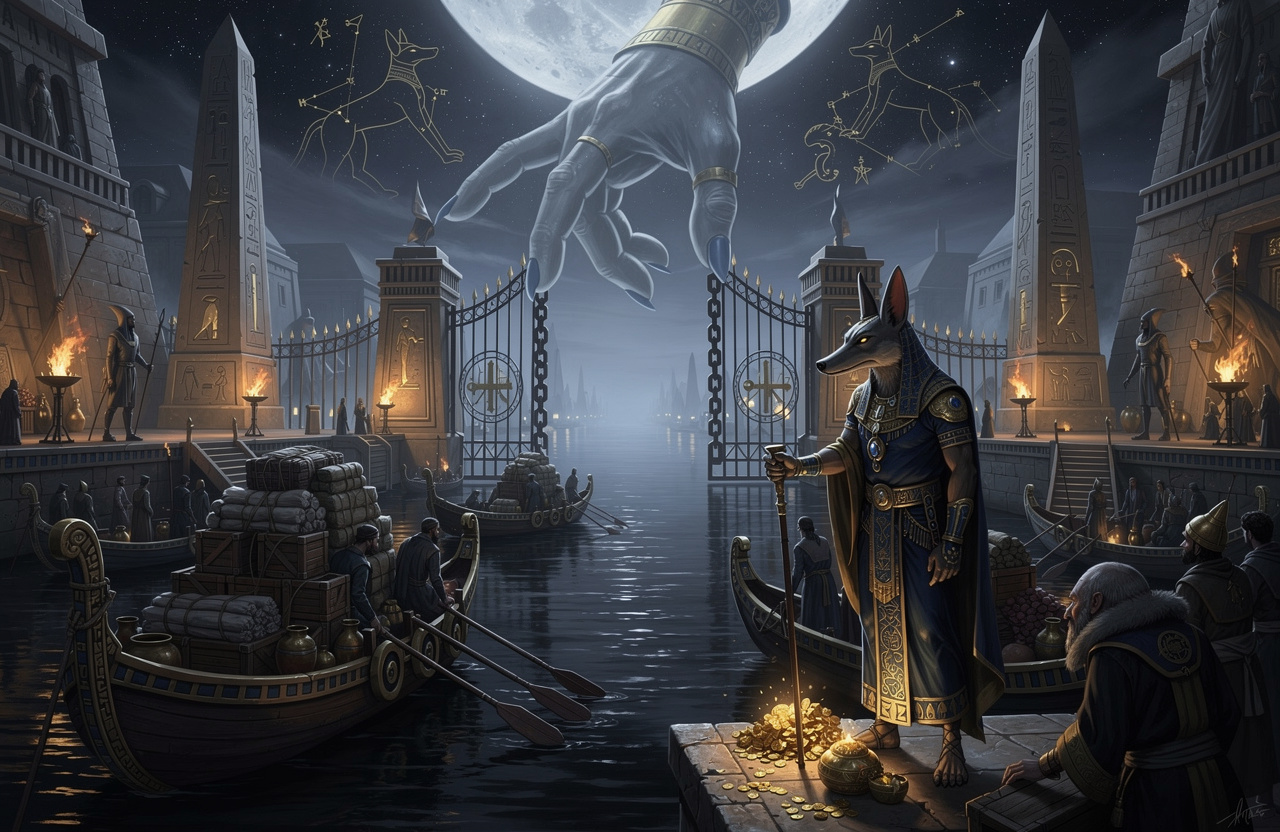
In the old cosmology, the world was fed by the flood. The Nile rose on schedule, and along it moved the barges — grain from the south, stone from the quarries, the whole life of a civilization carried on water. To control the river route was to control the breath of the land. That is why the temples and the crown sat where the goods had to pass.
Nothing has changed but the scale. The rivers are now shipping lanes; the barges are now container vessels; and the harbor where the flood must land is now a terminal owned, at the far end, by the Ring. The Shadow Neteru learned that you need not own the cargo, nor the sea, nor the maker. You need only own the narrow place — the quay where the flow of the whole world's Sekhem is forced through a single gate. Enclose the chokepoint, and every living thing downstream pays a toll to be fed.
This is Apep working not as storm but as the fence across the estuary. It does not sink the ships. It owns the mouths of the river and taxes the tide.
The lever: the gate is physical, and physical is local
Never doom without a door. Here is the door — and it is real, because unlike a stock or a search algorithm, a port cannot be run from a screen. It is concrete. It is dockworkers. It is a specific place with a specific community and a specific government that granted the concession.
That physicality is the Ring's exposure. A global fund can own a terminal from a spreadsheet, but it cannot love the harbor, cannot vote in the town, cannot answer to the crews. The concession that handed the gate to a private operator was a decision — and decisions can be reviewed, re-tendered, brought back under public or cooperative control where the vote still bites.
So the levers are old and concrete. Keep strategic terminals and canals in public or nationally-controlled hands, defended where accountability is local. Build port cooperatives and regional trade alliances so that no single distant owner holds the doorway to a nation's food and goods. And on the digital layer, push for open, transparent logistics — shared tracking, public fee schedules, ledgers anyone can audit — so the toll cannot hide inside the price of your shoes.
The Ring wants the gate because you cannot ship around it. So make the gate a commons, not a checkpoint. What the whole world must pass through, the whole world should be able to see the price of. Guard the harbor.