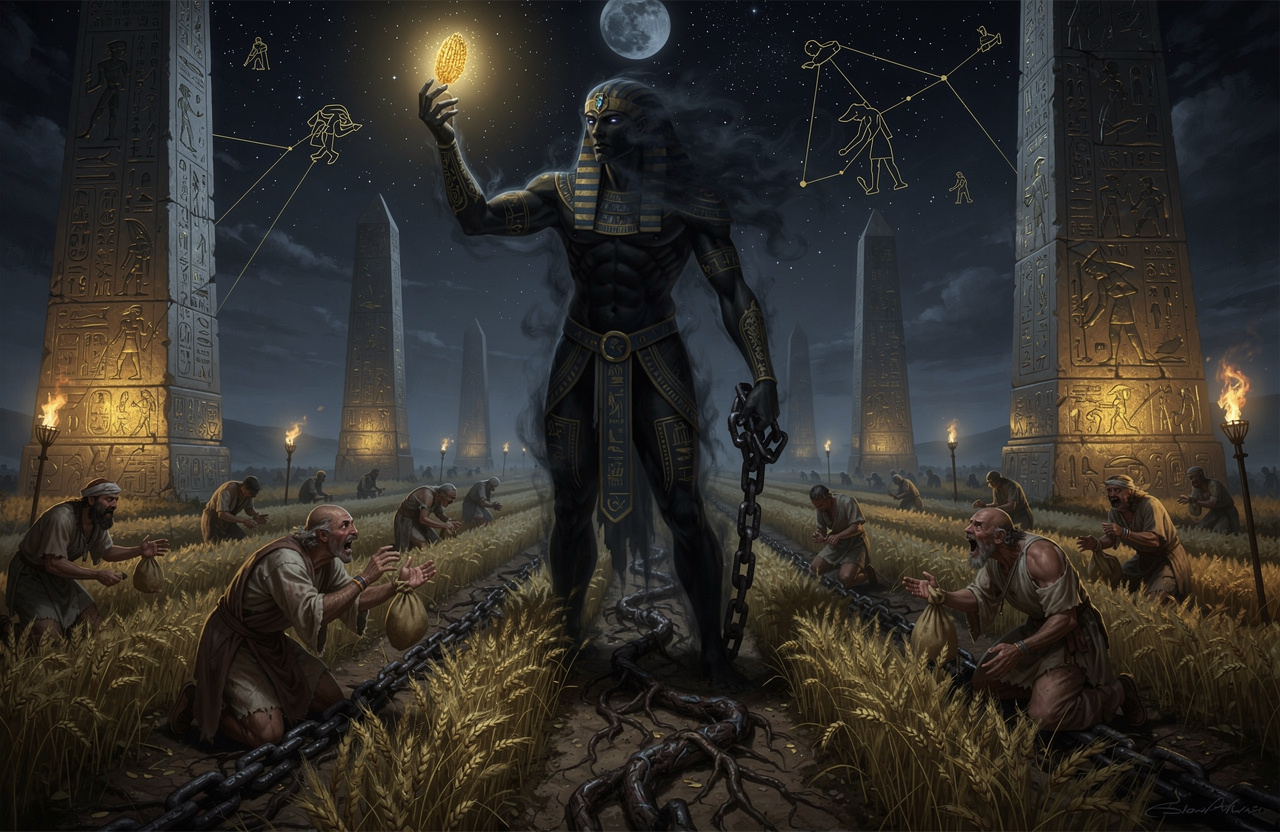
You can live a long time without a bank. A while without power. A few days without water. You cannot live without the harvest. And the harvest begins with a seed and the soil it feeds on.
So ask the oldest question in the world with new eyes: who owns the seed?
Not the farmer. Increasingly, not even the seed itself. Four companies — Bayer (which swallowed Monsanto), Corteva, Syngenta (now under ChemChina), and BASF — control the majority of the world's proprietary seed and crop-protection market. On top of the seed sits a patent. On top of the patent sits a license. And on top of the license sits a familiar register: Vanguard and BlackRock among Bayer's and Corteva's largest institutional holders, the same names you already know.
The patent on lunch
Here's the mechanism, stripped of PR. A traditional seed is self-replicating. That's the miracle of a seed — plant one, harvest thousands, save some, plant again next year. Ten thousand years of agriculture ran on that loop. The farmer owned the means of his own continuation.
A patented, genetically engineered seed breaks the loop by design and by contract. You don't buy the seed — you license it. Saving and replanting is prohibited. Next season you buy again. And the seed is often paired with a specific herbicide from the same company — Monsanto's Roundup and its Roundup Ready seeds being the textbook case. Buy the seed, you're steered to the spray. Buy the spray, you need the seed. A closed loop, and both ends bill you.
Now zoom out to fertilizer, the other half of the harvest. Nutrien — formed by the merger of Potash Corp and Agrium — is one of the largest crop-nutrient producers on Earth, with the Mosaic Company and a handful of others rounding out a tight oligopoly. When fertilizer prices spiked, these producers posted some of the fattest margins in their history. The soil got hungrier. The register got fed.
The whole loop, owned above
Stack it up. The seed is patented — owned. The herbicide keyed to the seed — owned by the same firm. The fertilizer the crop can't grow without — a four-name oligopoly. And sitting atop the public shares of most of these players, the same index giants that sit atop pharma, tech, and the grid.
This is the tightest ring in the whole system, because it wraps around the most non-negotiable need there is. You can boycott a brand of shoes. You cannot boycott eating. Demand for the harvest is the most inelastic demand on the planet — which is exactly why control over it is the most valuable coil to hold.
Our record
On the Scales, we call this the theft of the seed. In the old symbolism, the seed is Sekhem in its purest agricultural form — stored life-force, the vitality of next year folded into this year's grain. Osiris is the grain-god, buried and rising, the guarantee that death feeds life and the cycle renews itself. That cycle belonged to everyone. It was the commons of the living.
To patent the seed is to put a toll on Osiris. To key the herbicide to the seed and the license to the herbicide is to coil Apep around the resurrection itself — so that life renews, yes, but only through a gate someone owns, and only for a fee. The loop that once returned Sekhem to the farmer now returns it up the register.
Name it and the disguise slips. This isn't "innovation licensing." It's a rent placed on the oldest free thing there was.
Never doom without a door
Now, the honest part: this ring is real, but it is not sealed. Rings around necessities look total right up until the necessity finds another path. And the path here is old and stubborn — because seeds want to be free. That's not a slogan; it's biology. A seed's entire purpose is to copy itself. The whole patent apparatus is a legal cage built around an organism that has spent ten thousand years escaping cages.
Seed sovereignty is a movement, not a metaphor. Seed banks, heirloom and open-pollinated varieties, farmer-to-farmer exchange networks — these already exist, and they do the one thing the patent can't survive: they let the loop close on the farmer's side again. Every saved heirloom seed is a line of code the proprietary system can't recall.
Open-source seed is a live model. There are legal frameworks — pledges that keep a variety free to save, replant, and breed from, forever, immune to future patenting. It's the GPL, applied to genetics. A fork of the harvest that can't be un-forked.
Localize the soil. Compost, cover crops, regenerative practice, local nutrient cycling — these route around the fertilizer oligopoly by rebuilding the soil's own fertility instead of renting it by the ton. The four-name cartel prices nitrogen. It cannot price a living soil that makes its own.
The lever
The play isn't to out-buy Bayer. You won't. The play is to own the layer the ring forgot to enclose: the seed that can still copy itself, the soil that can still feed itself, the network of hands that still trade both freely.
Every ring in this series runs on the same trick — abstract the ownership up and away from the person who actually needs the thing. Break the pattern the same way each time: pull ownership back down to the ground. With the harvest, "the ground" is literal.
The register wants a patent on lunch. Answer with a seed it can never call back.
Save the seed. Feed the soil. Keep the loop closing on your side of the field.