You typed a question into a chatbot and got a fluent, helpful, well-mannered answer. It felt like magic. It felt like the machine simply knew. Now hold that feeling — and follow the wire behind it, all the way down, past the data centers and the GPUs, to a person in Nairobi or Manila sitting at a screen for nine hours labeling the worst content humanity produces, so that your answer could come out clean. They were paid, by some reports, around two dollars an hour. That is where the magic actually lives.
The polish on top is real. But it rests on a floor of invisible, underpaid human labor — and the industry has every reason to keep that floor invisible.
The machine does not learn by itself
There's a comforting story that AI "trains itself" on the internet. Half true. A raw model trained on scraped text is a firehose — it will happily explain how to build a weapon, spew slurs, and hallucinate with total confidence. What turns that firehose into a helpful assistant is a process built almost entirely out of human judgment.
Two human-powered stages do the heavy lifting:
- Data labeling and annotation. Every "cat" the model recognizes, every toxic phrase it learned to refuse, every boundary of "unsafe" was drawn by a person tagging examples, one after another, millions of times. The model has no innate sense of what's harmful. Humans installed it, by hand.
- RLHF — reinforcement learning from human feedback. Humans rank the model's answers: this one's better, this one's worse, this one's dangerous. Those rankings are the mold that shapes the model's manners. The "personality" you find so agreeable was sculpted by thousands of people clicking preferences on a piecework rate.
Strip these humans out and you don't have a smart assistant. You have a foul-mouthed autocomplete. The intelligence you're marveling at is, in large part, borrowed human labor, laundered through a neural net until its origin is invisible.
The floor nobody photographs
In 2023, reporting revealed that a major AI lab had contracted workers in Kenya, through an outsourcing firm, to label graphic descriptions of abuse, violence, and self-harm — the material needed to teach a safety filter what to block. The pay was reported at roughly $1.32 to $2 per hour. Workers described lasting psychological harm from reading the worst of the internet, shift after shift, so that the product could ship "safe."
This is not one bad contract. It's the shape of the industry. The annotation economy runs on Kenya, the Philippines, Venezuela, India — wherever labor is cheap, English is workable, and workers have little leverage. Platforms slice the work into microtasks paid by the piece, with no security, no benefits, and often no idea which billion-dollar company is on the other end. The value flows up. The trauma stays down.
Meanwhile the companies built on this labor are valued in the hundreds of billions. NVIDIA, selling the shovels, crossed into the trillions. The margins that make AI look like alchemy are, in part, simply the gap between what the labor is worth and what it's paid.
Our record
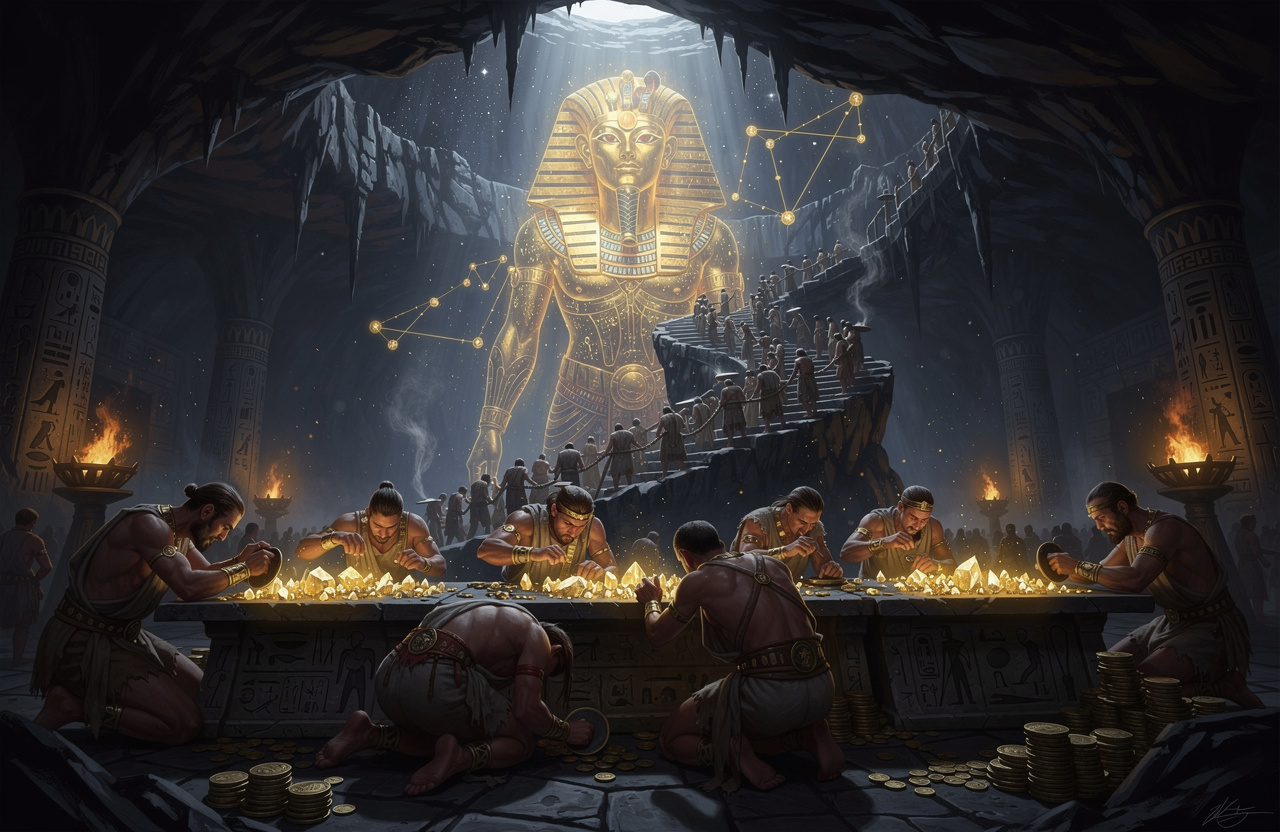
The Egyptians had a word for the vital force that animates a thing — Sekhem. Power, potency, the charge that makes a being alive and effective. And they knew that every great work — every temple, every fleet, every pyramid — was raised on borrowed Sekhem. Human hands, human strength, human hours, transferred into stone.
The honest builder honored the source. The name of the worker mattered; the offering was made; the labor was accounted for on the scales. That's Maat — the flow of vital force balanced by acknowledgment and return.
What the annotation economy does is extract Sekhem and erase the source. It draws the vital force — human attention, human judgment, human capacity to bear horror — out of the poorest workers on earth, pours it into a model, and then presents the result as if it emerged from silicon alone. The human is scrubbed from the story. That erasure is the Isfet: not the taking of labor, but the hiding of it, so the scales can never balance because one side has been made invisible. A debt that is never named can never be paid.
Why they need it hidden
The invisibility isn't an accident. It's load-bearing.
If the labor were visible — if every AI answer came with a footnote naming the person who taught it, and the two dollars they earned — the "magic" would collapse into "sweatshop." The valuations depend on the story that intelligence is being manufactured by machines, not harvested from people. Admit the harvest, and you have to talk about fair wages, working conditions, and mental health support. That conversation is expensive. Silence is free.
So the industry builds layers of outsourcing between itself and the worker — the labeler works for a platform, that works for a contractor, that works for the lab — precisely so no one has to look. It's the same trick every extractive system has ever used: put enough intermediaries between the beneficiary and the harmed that nobody feels responsible. A proprietary black box, all the way down to the human at the bottom.
The lever
The door here is bright, and it opens from your side.
- Name the labor. The single most powerful act is to stop calling it magic. Every time someone marvels at what AI "just knows," say where it came from: people, paid pennies, often traumatized. Naming the source restores it to the scales. An extraction that can be named can be challenged.
- Demand supply-chain transparency. The same way we learned to ask who sewed our clothes, ask who trained the model. Push for labor disclosure in AI the way we pushed for it in fashion. Companies respond to the questions they can't dodge.
- Support fair-work and cooperative models. There are efforts to organize data workers, set wage floors, and build annotation cooperatives where the workers own a share of what they create. Put weight there. A worker who owns part of the model is a worker whose Sekhem returns to them.
- Back open and communal AI. When models are open and their data and methods are in the light, the labor behind them can be seen, credited, and paid fairly. The black box hides the worker. The open system can honor them. That's not just ethics — it's the whole point of building this differently.
The machine did not teach itself. Somebody taught it, for two dollars an hour, reading the worst of us so your answer could be clean.
Say their name. That's where the balance begins.