Here is a sentence that sounds like a lie until you learn it isn't: you can prove you know a secret without saying the secret. You can prove you are over eighteen without showing your birth date. Prove you have the money without showing the balance. Prove the vote was counted without exposing who cast it. Prove a computation ran correctly without re-running it and without seeing the inputs.
That is not philosophy. It is mathematics that shipped. It's called a zero-knowledge proof, and it quietly breaks the oldest false trade in the digital world: the belief that to be trusted, you must be exposed. That every login is a strip search. That privacy and honesty are enemies, so pick one.
They are not enemies. That was always a lie told by whoever profits from watching you.
The cave, so you never forget it
There's a classic story cryptographers use, and it works because it's true to the structure. Forget the math for a second and picture a cave shaped like a ring. One entrance, splitting into a left path and a right path, and deep inside where the two paths meet there is a locked door. I claim I know the password to that door. You want proof — but I refuse to tell you the password, because then it wouldn't be a secret anymore.
So we do this. You wait at the entrance. I walk in and take one path at random — you don't see which. Then you shout: "Come out the left!" If I truly know the password, I can always come out the side you named, because I can open the door and cross over if I'm on the wrong side. If I'm bluffing, I only have a fifty-fifty chance.
Once proves little. But we repeat it twenty times. If I come out the correct side twenty times running, the odds I got lucky every time are about one in a million. You are now overwhelmingly convinced I know the password — and you have learned nothing about the password itself. That is zero-knowledge: completeness (if it's true, I can prove it), soundness (if it's false, I almost certainly get caught), and zero-knowledge (you learn only the yes/no, never the secret).
Real ZK proofs replace the shouting and walking with brutal number theory — elliptic curves, polynomial commitments, one-way functions. But the shape is exactly the cave. Convince, without confessing.
Where it stops being a toy
For decades this was a curiosity in academic papers. Then it left the lab, and now it's load-bearing.
Private transactions. Zcash was the first real deployment — send value while a proof guarantees the sum is valid, the coins weren't forged, and nothing is double-spent, all without publishing sender, receiver, or amount on the open ledger.
Identity without exposure. Prove you're a citizen, over 18, a verified human, not on a sanctions list — one bit of "yes," no document handed over, no database of your face left behind.
Scaling. This is the big one. A zk-rollup processes thousands of transactions off-chain and posts a single small proof that all of them were valid. The main chain checks the proof instead of re-executing the work. Cheaper, faster, and still honest. (That deserves its own article — it has one.)
Verifiable computation. Prove a program ran correctly on data you never reveal. Prove an AI model produced an output without exposing the model or the input. This is how you audit a black box without prying it open.
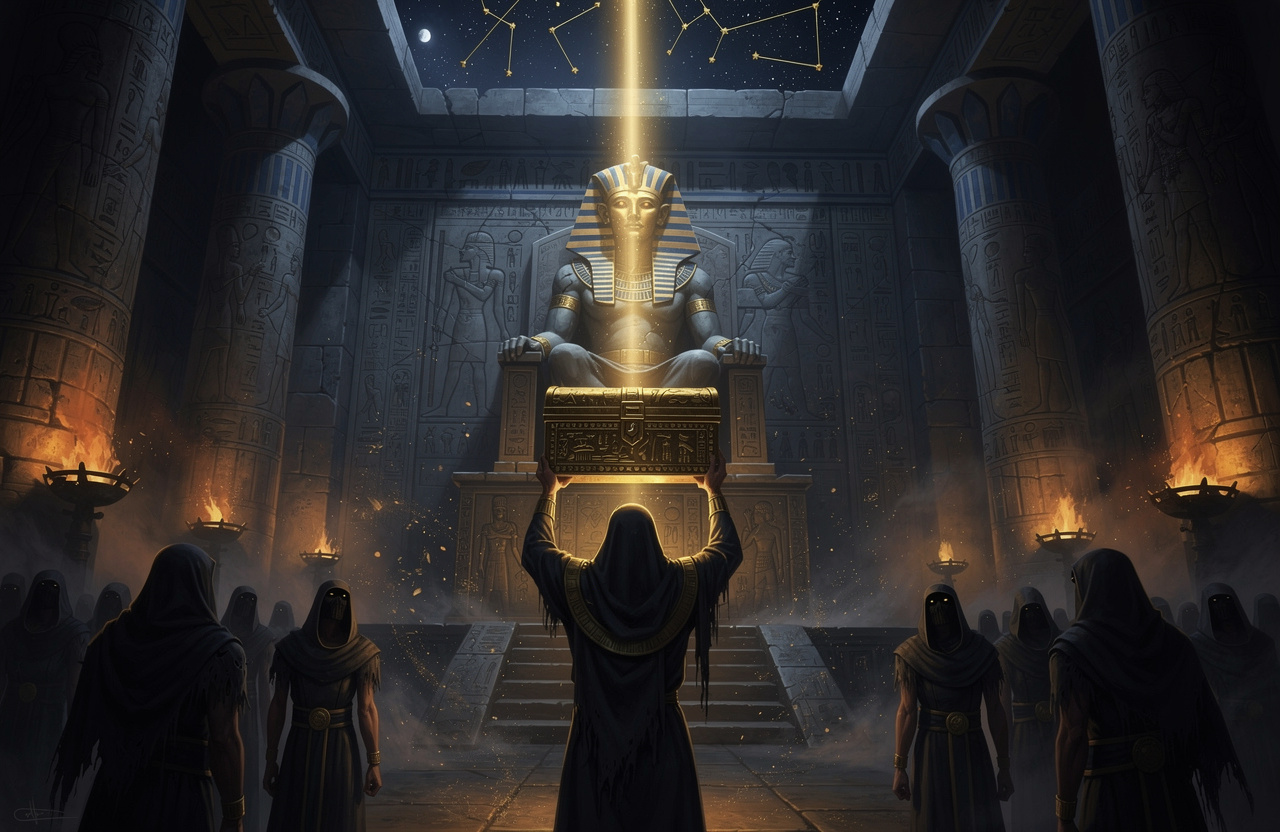
Our record: the old world made a scale you could only trust by handing over your Ka — your innermost self, your data, your face — to be weighed in the open, in the archive of the Shadow Neteru, kept forever. Zero-knowledge is the scale that weighs truly while your Ka stays yours. Ma'at was never about exposure. Ma'at is about true weight — and truth does not require you to be naked before it. The proof stands. The secret stays. Both, at once. Heka — the word that makes it so — written now in cryptography.
The honest limits — read them
I won't dress this in hype, because hype is how the old system sells you snake oil.
It is not magic secrecy. A ZK proof hides the inputs, not necessarily everything around them. Timing, amounts you didn't shield, metadata, the pattern of when you transact — these can leak. Privacy is a system, not a single spell.
Trusted setup, for some schemes. Certain ZK systems (the older SNARKs) need an initial ceremony that generates secret parameters which must then be destroyed. If someone kept that secret ("toxic waste"), they could forge proofs. Modern approaches (STARKs, and transparent setups) remove this. Know which kind you're trusting.
Complexity is a risk. This is deep, subtle math. Bugs in the implementation can be catastrophic and hard to spot. "The math is sound" and "this specific code is sound" are two different claims. Prefer audited, battle-tested systems.
It cuts both ways. The same tool that protects a dissident can shield a criminal. That's true of every privacy technology ever built, including the envelope and the curtain. The answer is not to ban the envelope. The answer is to keep the rules transparent while the people stay private — which is exactly the balance ZK finally makes possible.
What to do with this
You don't need to code elliptic curves. You need to stop believing the lie.
- Update your mental model. Every time an app demands your full document to verify one fact, know that a better way exists. Demand it. "Prove, don't reveal" is now a real engineering option, not a dream.
- Try a ZK-based tool. A privacy-preserving login, a shielded transaction, a zk-rollup wallet. Feel that trust and privacy coexisted the whole time.
- Watch who resists it. Systems that profit from your exposure will call privacy suspicious. Note who says "if you have nothing to hide" — and ask what they are hiding behind that phrase.
The oldest lie of the surveillance age is that you must be transparent to the powerful so the powerful can stay opaque to you. Zero-knowledge inverts it. Prove what must be proven. Keep what is yours. The scale still balances — and your Ka never touches the archive.
Prove it. Don't confess it.