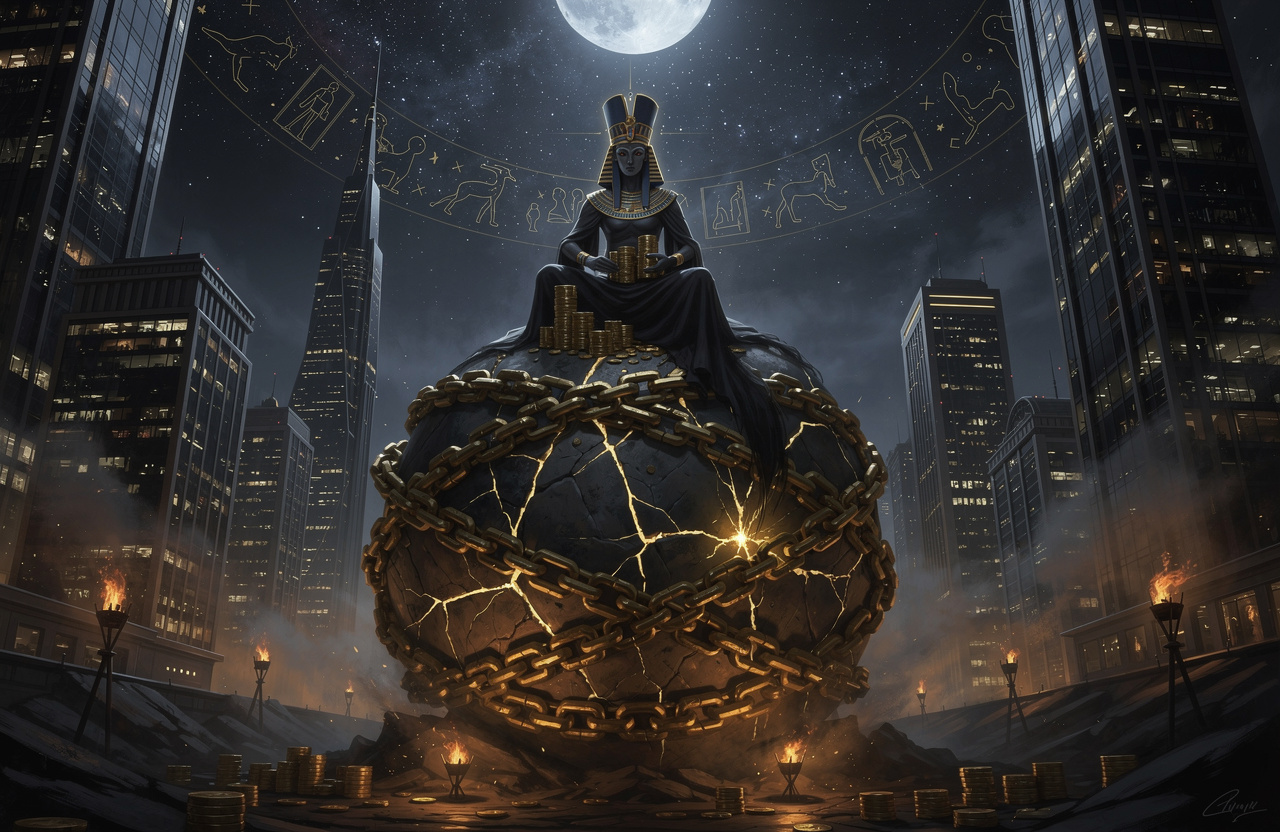
There is a number so absurd the brain refuses to process it: the total notional value of the world's derivatives is estimated in the hundreds of trillions of dollars — by some counts, far larger than all of world GDP combined. This is not money lying somewhere. It is the volume of bets placed on top of the real economy. And this structure sits right under the foundation of the whole system.
What a derivative is, in plain terms
The word is scary, the idea is simple. A derivative is a contract whose value is "derived" (hence the name) from something else: from the price of oil, an exchange rate, an interest rate, or whether a company goes bankrupt.
A crude analogy. There's a car — that's a real asset. And there's a bet on whether that car will crash by Friday. The bet is the derivative. Notice: you don't need to own the car to place the bet. And you can place a thousand such bets on one car — with a thousand different people.
Here's the trick. The real economy is finite: there's a limited number of houses, factories, barrels of oil. But the bets placed on top of them are nearly infinite. That's why the notional value of derivatives dwarfs the value of everything that actually exists. It's a superstructure of wagers built over a thin layer of real things.
What they're even for
Honestly: originally, for a good reason. Derivatives were invented as insurance. A farmer fears grain prices will fall by autumn — he locks in the price now with a contract and sleeps soundly. An airline fears a jet-fuel spike — it hedges with a derivative. This is a useful, sensible thing. Hedging risk.
The problem is that an instrument of insurance turned into an instrument of the casino. The overwhelming share of derivatives today is not farmers hedging a harvest. It is banks and funds betting against each other for profit. Insurance against risk became a game in its own right, and the volume of the game came to dwarf the volume of what is being insured.
Why it's a bomb
Now comes an engineering problem any IT person recognizes instantly: hidden dependencies.
Each derivative is a contract between two parties. Bank A owes Bank B on one bet. Bank B has built that claim into a bet with Bank C. C hedged with D. You get a graph of links where everyone owes everyone down the chain. While things are calm the graph looks balanced: one party's pluses cancel another's minuses.
But this works under one condition only — as long as everyone pays. Let one large node fail to pay, and suddenly the bet the neighbor was counting on isn't honored. The neighbor can't settle with his neighbor. The collapse runs down the chain. In IT this is called a cascading failure: one server goes down and the load topples the next, and the next.
That is exactly what happened in 2008. The insurer AIG had sold derivatives (those credit default swaps — insurance against default) in amounts it physically could not cover if the market turned against it. The market turned. AIG became the node whose fall would drag down half the system. And it was rescued with taxpayer money — because "otherwise everything collapses."
"Financial weapons of mass destruction"
That's not a slogan off a placard. That's what Warren Buffett called derivatives — a man hard to suspect of radicalism, one of the most famous investors in the world. He warned about it before the 2008 crisis. The core of his complaint: nobody fully understands the real size of the mutual obligations, because most of these contracts are struck directly, off-exchange, in the dark.
And Isfet, as the book says, works precisely in the dark. A closed door feeds it. A web of bets that can't be seen whole is the ideal environment: while everything rises, each node skims a fee and a profit; when everything falls, the losses suddenly turn out to be "systemic," and everyone else is called to pay for them.
Where is the ordinary person in this
You don't play in this casino. You don't even know the rules. But when the bomb goes off, the bill comes to you — through bank bailouts from the budget, through the collapse of pension savings (which are invested in the very same institutions), through inflation from the trillions printed to rescue them. The profit from the bets is private. The loss from the explosion is shared. You weren't invited to the table, but you pay for the broken dishes.
The answer: the MAAT token and DAO
The derivative bomb rests on two pillars: opacity (no one sees all the links) and impunity (winnings are privatized, losses nationalized). So the opposite structure must rest on transparency and on the principle that decisions are made not by the players with the biggest table, but by people.
That is the logic of MAAT. The MAAT token is membership in a cooperative and a vote — and one human, one vote, not "whoever has the most bets is right." Governance runs through a DAO — a decentralized organization with a transparent treasury on the blockchain, where every movement of funds is visible to all. Here it's impossible to quietly pile up hidden obligations in the dark: everything the treasury does is visible by default, because Isfet lives behind closed doors and open doors disarm it.
The system of bets upon bets was built so that you stay a spectator who pays in the end. MAAT is about the opposite: seeing every movement and having a vote in what's done with shared money. The entry is simple: read the book, take the token, get your vote — and stop being the one handed the bill for someone else's game.