Here is a sentence that should stop you cold. When the United States needed someone to run its emergency money-printing operations, it did not build a tool. It hired a company. Twice. And the company was BlackRock.
- 2020. Two crises, two rescues, and both times the U.S. Federal Reserve — the institution that literally creates dollars — turned to a private firm to decide where those dollars would go. The regulator handed the steering wheel to one of the largest entities it is supposed to regulate. And the man in the driver's seat was Larry Fink.
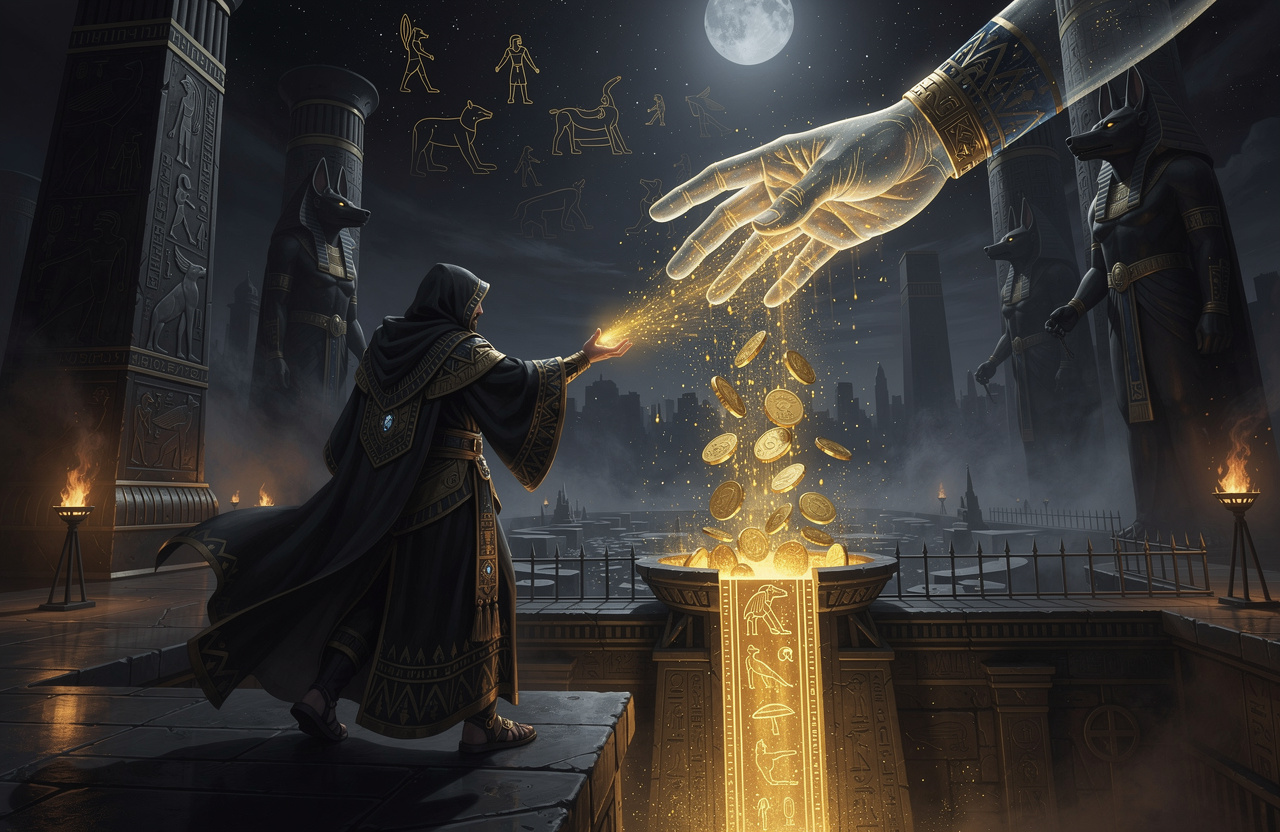
Look at that shape. The one who prints the money, and the one who directs the money, standing in the same room, and increasingly it's the same hand on the wheel.
2008: the first contract
When the mortgage system detonated in 2008, the Fed and the Treasury found themselves holding wreckage they didn't understand — Bear Stearns' toxic book, AIG's collapse, Maiden Lane portfolios full of assets nobody could price. They needed someone who could price them.
They called BlackRock. Specifically, they called BlackRock Solutions — the analytics arm running Aladdin, the risk platform that already sat under a huge share of the world's portfolios. BlackRock was hired to value, manage, and unwind the government's crisis assets. The firm that helped model the mortgage-backed securities world was now hired to clean up the mortgage-backed securities world. Poacher and gamekeeper, on the same payroll.
Why them? Because of Aladdin. When your risk system already sees inside a large fraction of the planet's bonds and mortgages, you're not just a vendor. You're the vendor. There's no one else with the map. The dependency is the moat.
2020: the mask comes off
2008 you could half-explain as an emergency improvisation. 2020 removed all doubt.
When COVID froze the credit markets, the Fed did something it had never done: it announced it would buy corporate bonds and corporate-bond ETFs directly. And who did it hire to run those purchase programs? BlackRock. The same firm whose iShares ETFs were among the very instruments the Fed was buying.
Sit with that. The Fed hired BlackRock to buy bond ETFs, and some of the ETFs getting bought were BlackRock's own products. The purchasing agent and one of the product manufacturers — one company. Officially there were walls, fee waivers, disclosures. And officially the fox files a report before entering the henhouse. The structure is the scandal, regardless of how clean any single transaction was.
Our record. This is Isfet's masterstroke — not breaking the Scales of Maat, but becoming the hand that holds them. Maat is the principle that the one who judges must stand apart from the one who is judged. Weigh the heart against the feather — but never let the heart weigh itself. When the regulator and the regulated fuse into one, the Feather is still there, the ceremony still runs, but the outcome is decided before the weighing begins. That is the deepest counterfeit the Shadow Neteru knows: not to destroy the Scales, but to run them. The ritual continues. The verdict is pre-committed. A rigged oracle that still returns a signed response.
Aladdin: the real seat of power
Forget the contracts for a second. The contracts are downstream of something bigger.
Aladdin — BlackRock's risk and portfolio platform — monitors risk across tens of trillions of dollars in assets. Not BlackRock's assets. Everyone's. Pension funds, insurers, other asset managers, and yes, at moments, arms of the government itself run on Aladdin's numbers. It is, functionally, a shared nervous system for a huge slice of global capital.
Think about what that means. If a single platform tells thousands of institutions what their risk is, then when Aladdin flinches, they all flinch together. The tool that was built to manage risk becomes a mechanism for synchronizing it — a single point of failure disguised as a safety feature. Everyone running the same proprietary black box, trusting the same outputs, and no one able to read the source.
That's the real reason the Fed keeps calling. Not because BlackRock is the biggest asset manager — though it is, with trillions under management. Because BlackRock is the only entity that already has the instrument panel wired into everything. When the plane is falling, you hire the company that built the cockpit. Even if that company also owns a fleet of the planes.
The lever
Never doom without a door. So here's the door.
The problem isn't Larry Fink's ambition. Ambition is cheap and universal. The problem is architectural: we built a financial system with a single privileged reader of everyone's risk, and a single privileged agent for the money-printer, and let them be the same firm. Concentrate the oracle, and whoever holds the oracle holds the outcome.
The counter-move is not to smash BlackRock. It's to make its position obsolete by building systems that don't need a trusted central reader.
That's the whole thesis of open, on-chain finance. On a public ledger, risk and ownership are visible to everyone, not licensed from one vendor. The "Aladdin" of a decentralized system is open-source — auditable by anyone, owned by no one, incapable of being quietly captured because there's no private seat to capture. Transparency by construction, not by disclosure form. And an open AI you can inspect, instead of a proprietary risk engine you must trust.
So learn the shape. When someone says "the Fed hired an outside expert," ask which expert, and what else that expert owns. Move a portion of your own capital onto rails where the ledger is public and the keys are yours. Support the projects trying to build the open oracle — the one no single hand can hold.
The one who prints and the one who directs became the same hand because the room was dark and the door was single. Build another room. Build many doors.
Then no hand can hold the Scales but your own.