If "one token, one vote" hands the vote to the whale, the obvious question is: what replaces it? Not a slogan. A mechanism — one with real math under it, and real weaknesses you should know before you trust it.
That mechanism is quadratic voting. It doesn't abolish money's influence — nothing does. But it bends the curve. It makes the second vote cost more than the first, and the tenth cost far more than the second. It taxes concentration. And that changes who wins.
Let me show you the math, then show you where it breaks. No mechanism deserves your trust until you've seen both.
The core trick: votes cost their square
In ordinary token voting, buying influence is linear. Want ten times the say? Buy ten times the tokens. Simple, and brutal for the small holder.
Quadratic voting changes the price. To cast n votes on an issue, you pay n squared in credits. One vote costs 1. Two votes cost 4. Three cost 9. Ten votes cost 100.
Feel what that does. The first vote is cheap — everyone can afford to be heard once. But piling on gets expensive fast. To shout ten times louder than your neighbor, you don't pay ten times more. You pay a hundred times more. The cost of domination explodes.
Flip it around: the same budget spread across many people buys far more total votes than concentrated in one. A hundred people casting one vote each = 100 votes for 100 credits. One person trying to match them alone needs 100 votes = 10,000 credits. The crowd is a hundred times more efficient than the whale. That's the whole idea. Breadth beats depth.
What it's actually for
Quadratic voting isn't just anti-whale. It solves a subtler problem: intensity.
Plain majority voting can't tell the difference between "I mildly prefer A" and "this issue will destroy my life." Everyone gets one flat vote. A large group that mildly cares can steamroll a small group whose whole existence is at stake. Quadratic voting lets you spend more credits on the issues you care about most — but at a rising cost that stops you from dominating everything. You get to say how much something matters, not just which side you're on, and the square-root curve keeps that expression honest.
The result, in theory, is a system where a passionate minority can protect what matters to it, a broad consensus still carries the day, and no single deep pocket can quietly buy every outcome. Influence tracks how many people care and how much, instead of who has the most money.
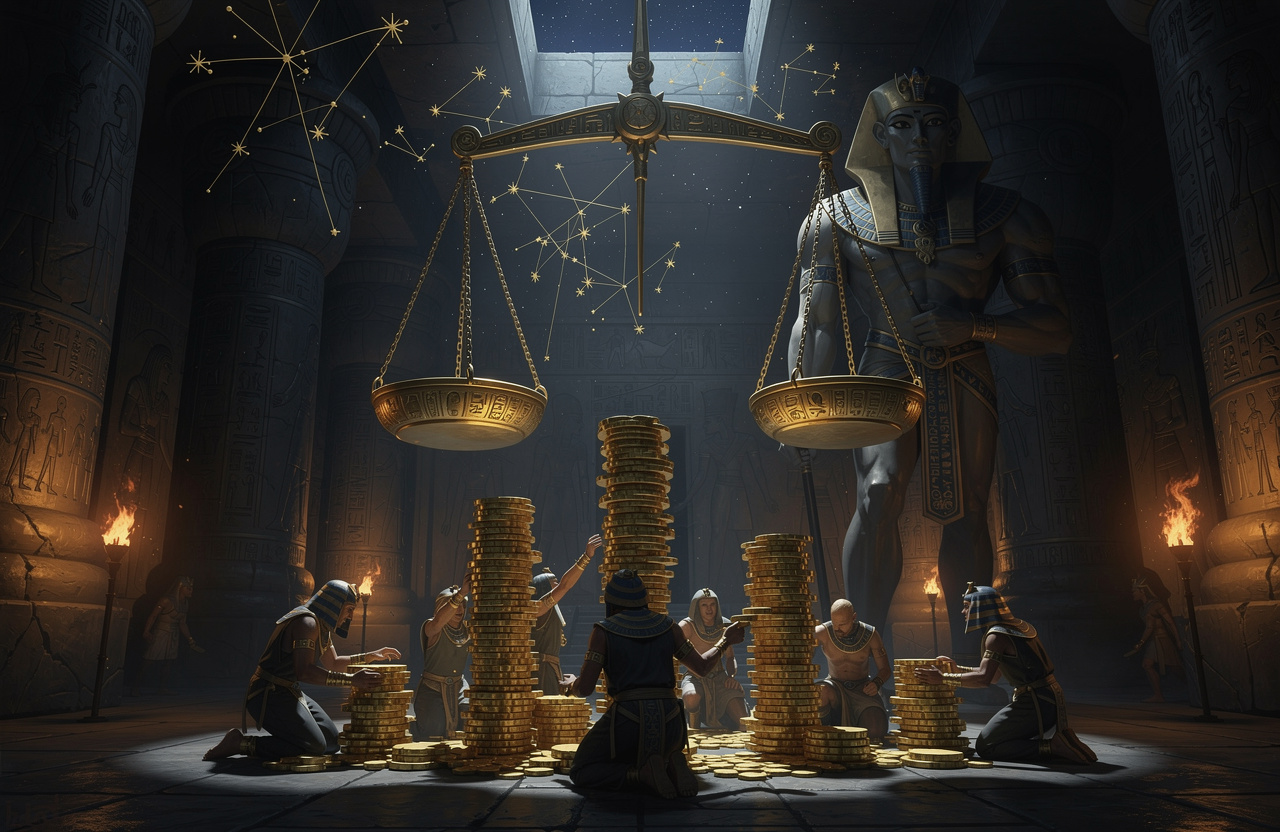
Our record. The Scales of Maat weigh a single deed against a single feather — one truth, one measure. Token voting corrupts the Scales by letting a wallet stack coins on its own pan until the feather can never rise. Quadratic voting is an attempt to re-true the balance: to make the pan resist the coin, so that weight comes from many hearts and not one hoard. It doesn't make the Scales perfect. It makes them harder to bend. And in a world where Isfet's whole craft is bending the instrument of judgment, "harder to bend" is not a small thing. It is the difference between a scale and a scam.
Now the honest part: where it breaks
Here's what the hype won't tell you. Quadratic voting has a fatal enemy, and its name is the Sybil attack.
The entire mechanism rests on one assumption: one person, one account. The square-root cost only taxes the whale if the whale can't split into many wallets. Because — watch — if I have 100 credits and I must vote from one identity, I get 10 votes (100 = 10 squared). But if I split those credits across 100 fake identities, one credit each, I get 100 votes. The quadratic tax evaporates. The whale beats the system simply by pretending to be a crowd.
This is not a minor caveat. It is the problem. Without a way to prove that each account is a distinct human being — proof of personhood — quadratic voting is worse than useless, because it looks fair while being trivially gamed by anyone patient enough to spin up wallets. (The next piece in this series is entirely about Sybil attacks and personhood, because you cannot understand one without the other.)
There are lesser problems too, and I won't hide them:
- Collusion. People can pool credits or trade votes off-chain, re-concentrating what the mechanism spread out.
- Personhood is hard and imperfect. Every method of proving you're a unique human — biometrics, social graphs, government ID — carries its own privacy cost or failure mode. There is no clean answer, only tradeoffs.
- Complexity. Quadratic voting is harder to explain and harder to use than "click yes or no." Friction lowers turnout, and low turnout has its own capture risks.
Anyone selling you quadratic voting as a finished solution is selling you a half-built bridge. It is a genuine improvement only when it stands on solid personhood — and personhood is its own unsolved frontier.
The lever
So why bother, if it's imperfect? Because the alternative — pure token weight — isn't imperfect. It's designed to let money win. Quadratic voting is a real attempt to make the crowd cheaper than the whale. That's not utopia. It's a better curve. And in mechanism design, a better curve is a real victory.
Here's what to do with this:
- Treat quadratic voting as a tool, not a miracle. It weakens the wallet's grip. It does not remove the wallet.
- Always ask about personhood first. If a project touts quadratic voting but can't tell you how it stops Sybil attacks, the quadratic part is decoration. Check the foundation before you admire the architecture.
- Value breadth over depth in any vote you can. The core insight travels beyond crypto: a system that rewards how many people care, taxed against how hard any one person can push, is structurally harder to capture.
Democracy is a machine, and machines can be redesigned. One token, one vote gave the deepest pocket the loudest voice. Quadratic voting makes the loudest voice pay dearly for every decibel. That is the lever — a price on domination itself.
Weigh many hearts, not one hoard. That is the balance we are trying to re-true.